


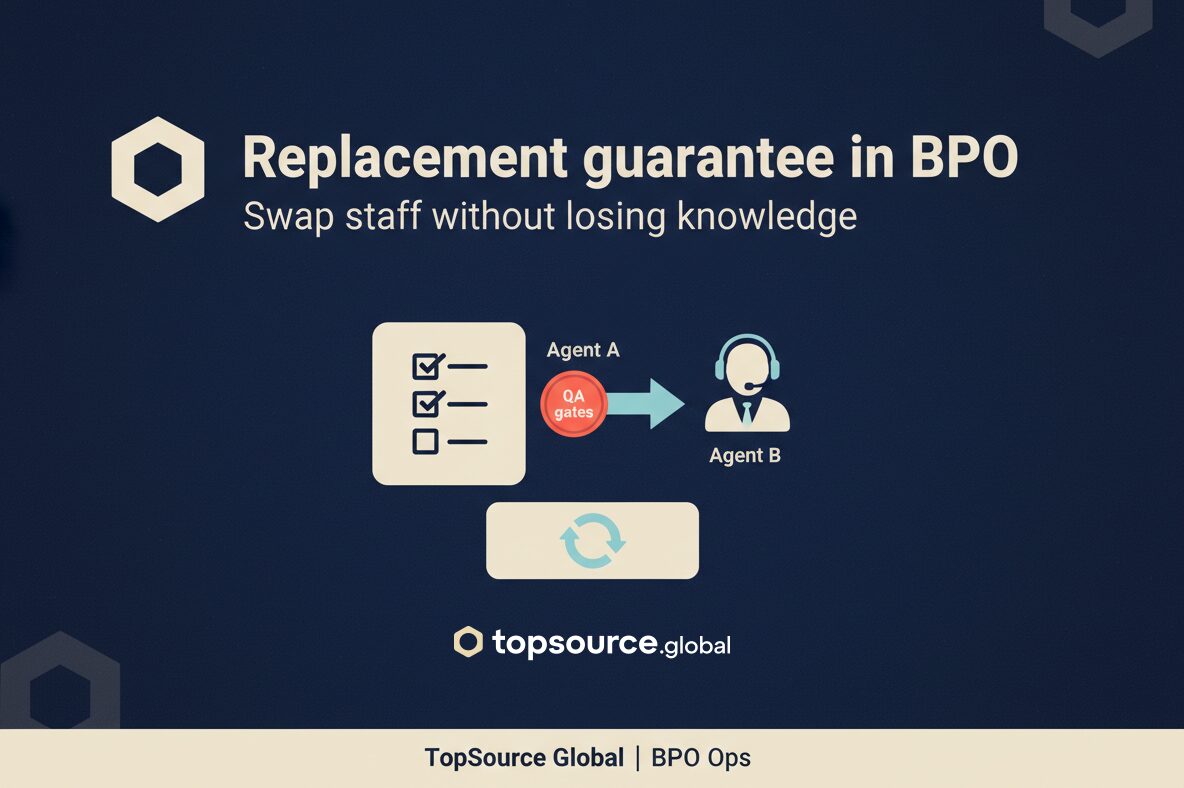
Replacement guarantee in BPO is easy to sell and hard to execute. On paper, the vendor replaces an underperforming agent “for free.” In real operations, a swap can create a quality dip, backlog growth, missed SLAs, and a second-order mess: tribal knowledge disappears and the process starts drifting. A replacement guarantee in BPO only works when the transition is designed to survive a swap.
This article is a practical playbook for replacing ops staff without losing knowledge. It’s written for COOs, ops leaders, and finance owners who need continuity more than promises.
Replacement guarantee in BPO: what it covers (and what it doesn’t)
Most replacement guarantees assume the role is interchangeable. In back-office and e-commerce ops, it rarely is. Knowledge lives in places that don’t show up in a job description:
- Implicit rules – “how we actually do it,” not what the SOP says.
- Exception handling – edge cases, workarounds, and escalation paths.
- System context – where data comes from, what breaks integrations, what fields matter.
- Stakeholder expectations – what the client tolerates, what triggers an escalation.
That’s why “swap the person” is not the unit of work. The unit of work is transfer + validation.
The minimum viable handover pack (what must exist before a swap)
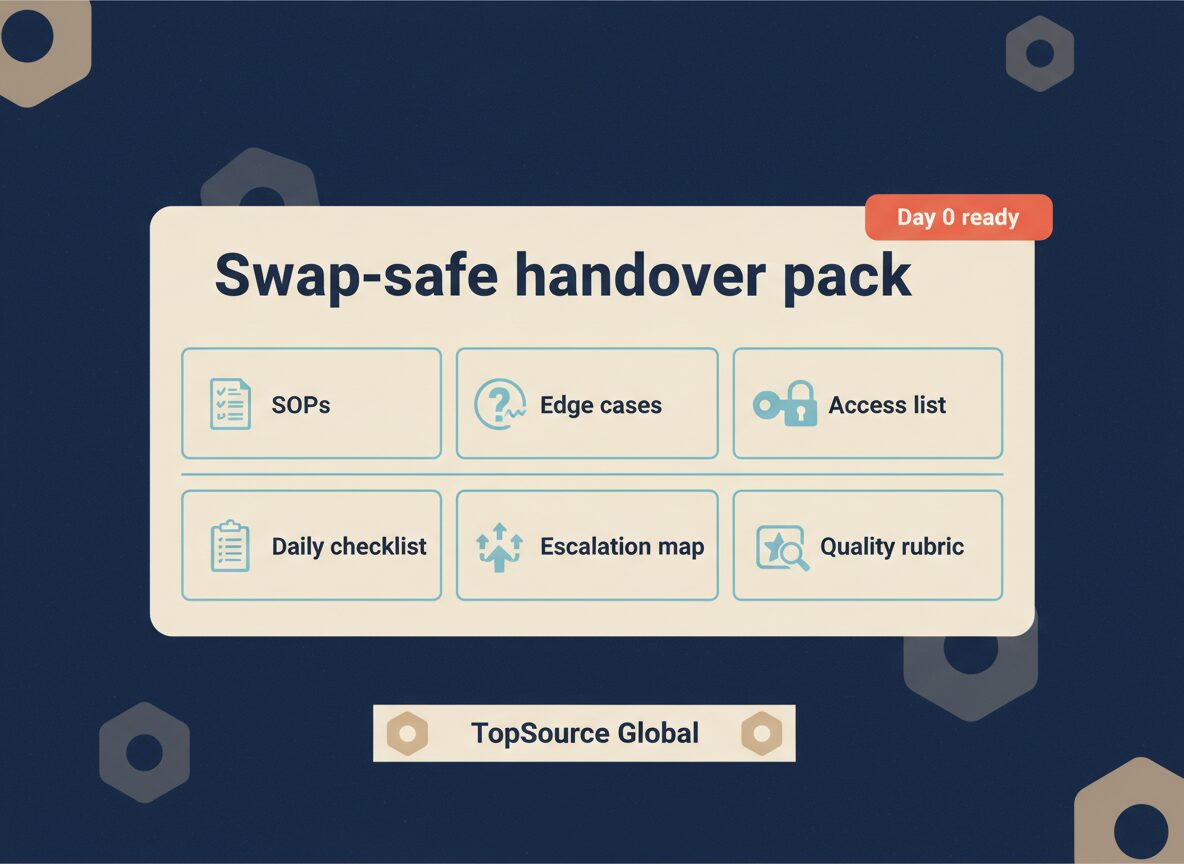
If a vendor offers a replacement guarantee, the vendor should also maintain a handover pack per role. Keep it short, versioned, and usable by a new hire on day one.
- Role charter: what the role owns, what it does not own, and what “done” means.
- Daily/weekly checklist: the recurring tasks with cut-off times and expected outputs.
- SOPs that match reality: step-by-step, with screenshots only where they reduce ambiguity.
- Exception map: top 20 exceptions, how to detect them, and what action to take.
- Escalation rules: triggers, severity levels, who is on point, expected response times.
- Access + tooling list: systems, roles, shared inboxes, templates, macros, saved searches.
- Quality rubric: what is scored, how it is scored, and what fails QA.
This aligns with common transition best practices: structured documentation, clear ownership, and measurable checkpoints during handover.
How to run a replacement without downtime: overlap, shadow, cutover
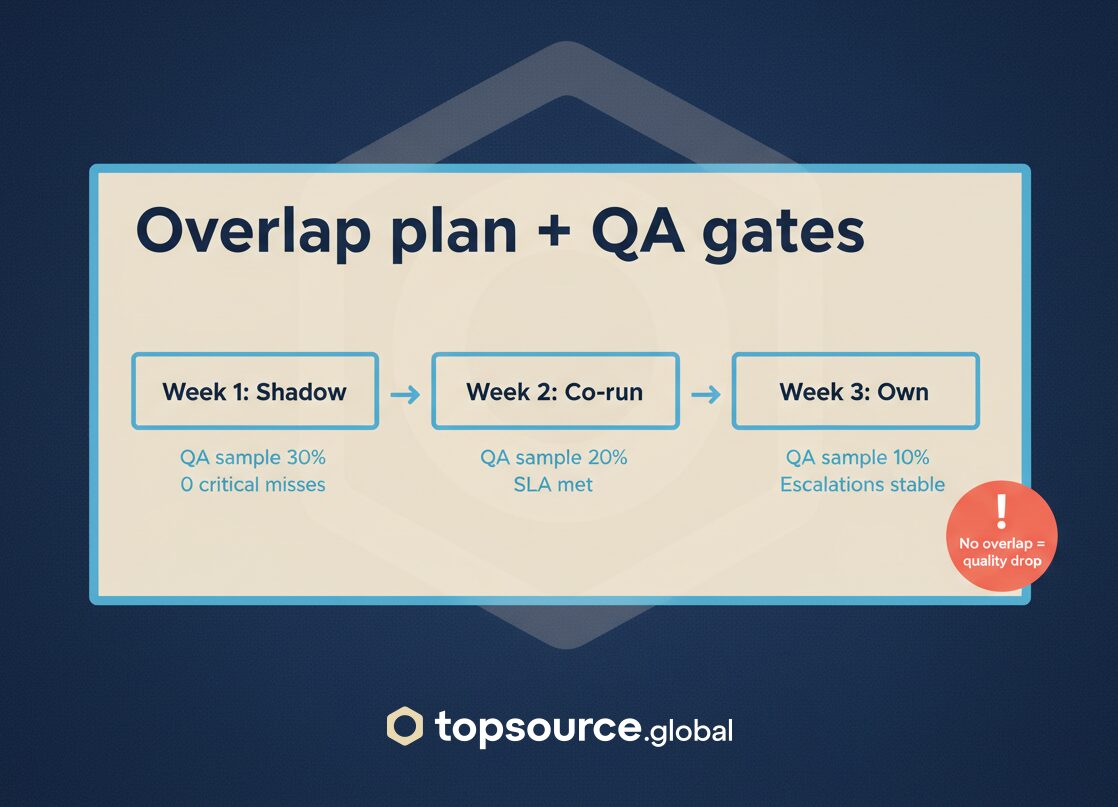
Do not cut over on a calendar date. Cut over on evidence. A simple model works across most ops functions:
Phase 1 – Shadow (observe)
- New agent watches live work and reviews recent tickets/orders/cases.
- KT sessions cover explicit knowledge (SOP) and tacit knowledge (why decisions are made).
Phase 2 – Reverse shadow (do with supervision)
- New agent executes tasks while the incumbent reviews before submission.
- Track error types. Update the exception map immediately.
Phase 3 – Controlled cutover (do independently with QA sampling)
- New agent runs the queue with increased QA sampling for 1-2 weeks.
- Escalations route to a named backup, not “the team.”
Knowledge transfer literature consistently separates explicit vs tacit knowledge and recommends interactive transfer methods (shadowing, walkthroughs, recordings) to prevent gaps during transitions.
What to measure during the swap (so quality doesn’t drift)
Replacement guarantees should be tied to operational metrics, not headcount. During a swap, track a short list daily:
- Backlog: open items by age bucket (0-24h, 24-48h, 48h+).
- SLA attainment: response and resolution separately.
- QA score: pass rate and top 3 defect categories.
- Rework rate: % items reopened or corrected.
- Escalation volume: count and severity.
If any metric moves beyond an agreed threshold, pause the cutover and extend overlap. This is cheaper than letting drift compound for a month.
This is the point where a replacement guarantee in BPO either protects outcomes or becomes a churn machine.
Common failure modes (and how to prevent them)
- “SOP exists” but is outdated – fix with versioning and weekly calibration notes.
- Access delays – pre-provision roles and test logins before day one.
- No owner for edge cases – assign a named backup and define escalation triggers.
- QA is too light – increase sampling temporarily and score the same rubric.
- Client expectations are implicit – document “what good looks like” with examples.
How to write a replacement guarantee that is operationally real
If the guarantee is only “we replace the person,” it’s marketing. A real guarantee includes process controls:
- Defined handover pack maintained by the vendor.
- Overlap requirement (hours or volume-based) for critical roles.
- Temporary QA uplift during transition.
- Clear thresholds for pausing cutover and extending shadowing.
- Named escalation owner for the first 30 days.
In other words: the guarantee is a transition system, not a staffing promise.
Implementation checklist (copy/paste)
- Handover pack exists and is current (last update date visible).
- Top exceptions documented with examples.
- Access is provisioned and tested.
- Shadow + reverse shadow scheduled.
- QA rubric agreed and sampling plan increased.
- Daily metrics dashboard defined for the swap window.
- Cutover criteria defined (evidence-based).
Need a replacement guarantee that doesn’t break operations? TopSource Global builds transition playbooks, QA scorecards, and KPI-driven delivery models for high-volume e-commerce and back-office teams. Talk to us about a swap-safe operating model.