


Cancellation management outsourcing is the fastest way to stop losing margin to late cancels, duplicate shipments, and refund chaos when your order volume outgrows your internal team. The work is not “answering tickets”. It is a control loop across OMS, ERP, payment, and the warehouse that decides what can still be stopped, what must ship, and what needs a clean audit trail.
This playbook describes how to run cancellations in a typical stack (Shopify + Amazon MFN + NetSuite + 3PL/WMS), what to measure, and what to automate first.
If you want the cancellation desk built as a managed process with KPIs and escalation rules, see our Back Office BPO coverage or contact TopSource.
What cancellation management outsourcing actually covers
Cancellation management is a cross-system workflow that starts when a customer or ops requests a cancel and ends only when one of these outcomes is true:
- Order is stopped before fulfillment and no shipment is created.
- Order ships and the cancel is converted into a return/refund workflow with correct reason codes and timestamps.
- Order is blocked for fraud or compliance and cancelled with documented evidence.
In practice, cancellation management outsourcing includes:
- Intake and classification (customer-initiated vs ops-initiated vs auto-cancel).
- Stop-ship execution (3PL hold, WMS cancel, carrier intercept rules when applicable).
- ERP/OMS updates (NetSuite sales order status, holds, reason codes, audit notes).
- Payment actions (void vs refund, partials, timing rules, reconciliation flags).
- Customer comms with SLA and templated outcomes.
- Exception queue handling and escalation to warehouse, fraud, finance.
Why cancellations break at scale (the failure modes)
Cancellations become expensive when the business has multiple channels and a split fulfillment model. Typical failure modes:
- Late cancel: the request arrives after pick/pack starts, but the system still shows “unfulfilled”.
- Stop-ship gap: ERP is updated but the 3PL never receives a hold/cancel signal.
- Double cost: order ships anyway, then you refund, then you pay return shipping and handling.
- Reason-code noise: cancellations are logged as “customer changed mind” even when the root cause is stock, lead time, fraud, or address issues.
- Finance drift: void/refund timing is inconsistent, creating reconciliation backlog and month-end clean-up.
Cancellation management outsourcing KPIs (what to measure weekly)
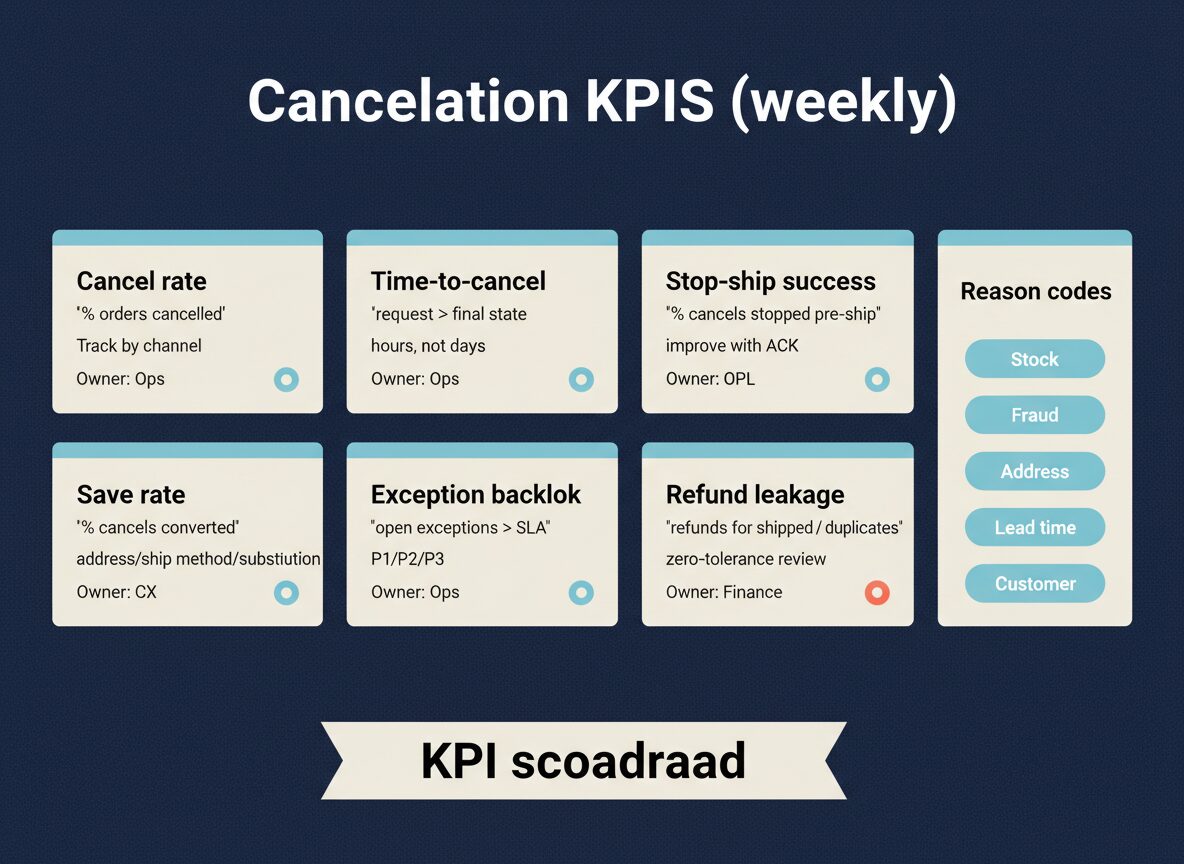
Cancellation metrics need to separate “avoidable” from “structural”. Track these as a weekly control loop:
- Cancellation rate by channel and fulfillment type (in-house, 3PL, drop ship).
- Time-to-cancel: request timestamp to final system state (cancelled or shipped).
- Stop-ship success rate: % of cancel requests stopped before shipment confirmation.
- Save rate: % of cancels converted into address fix, ship method change, backorder approval, or substitution.
- Refund leakage: refunds issued for orders that still shipped, or refunds issued twice.
- Exception backlog: open cancellation exceptions older than X hours.
For Amazon seller-fulfilled orders, Amazon tracks a “pre-fulfillment cancel rate” metric and publishes a target below 2.5% as an account health guideline. Treat it as an external reference point, not a universal benchmark across all channels: Amazon pre-fulfillment cancel rate target.
Stop-ship workflow: the 8-step cancellation desk process
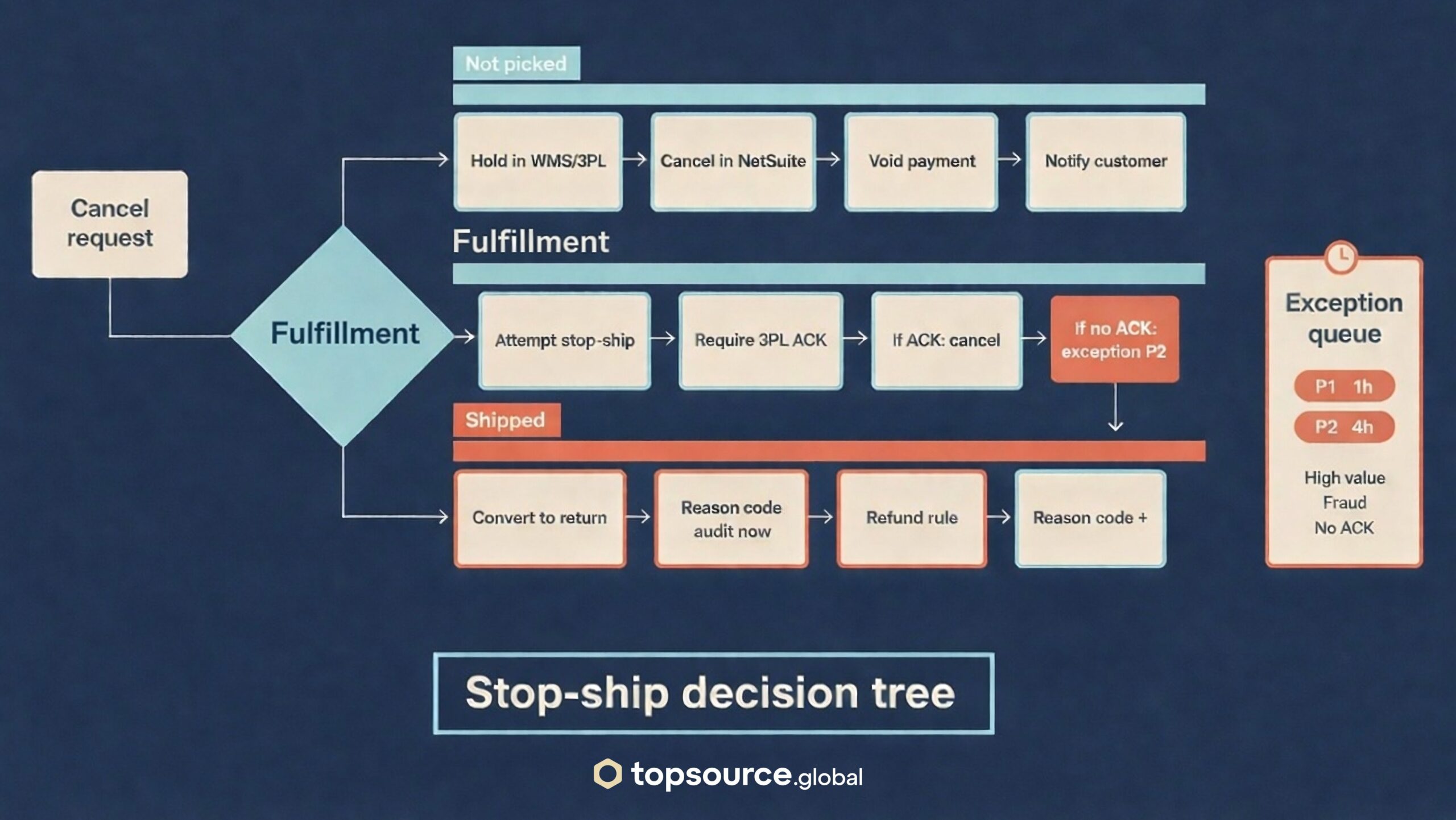
This is the core of cancellation management outsourcing. The goal is to make “stop-ship” deterministic and auditable.
- Normalize intake: one queue for cancels (email form, support ticket, marketplace message). Capture order ID, channel, reason, and timestamp.
- Classify: customer request, ops request (stock, fraud, address), auto-cancel (payment timeout).
- Check fulfillment state: not just “unfulfilled”. Pull pick/pack status from WMS/3PL and shipment creation status.
- Apply stop-ship rule: if not picked, place hold + cancel; if picked, attempt hold; if shipped, convert to return workflow.
- Execute 3PL/WMS action: send hold/cancel with a required acknowledgment. No acknowledgment means the cancel stays in exception state.
- Update NetSuite: status, cancellation reason code, internal note, and linkage to the ticket ID for audit.
- Payment action: void if not captured; refund if captured; enforce timing rules to avoid double actions.
- Close the loop: customer notification + SLA timestamp + root cause tag for reporting.
NetSuite controls: statuses, reason codes, and audit trail
Cancellation management outsourcing fails when NetSuite is treated as a passive ledger. You need a small set of controls:
- Standard cancellation reason codes mapped to actions (stockout, fraud, address, lead time, customer request, duplicate order).
- Hold types that block fulfillment and trigger an exception queue (fraud hold, address hold, warehouse hold).
- Ticket linkage in the sales order record (case ID / Jira ID) so finance and ops can trace decisions.
- Timestamp fields for request received, stop-ship sent, stop-ship acknowledged, final outcome.
Even without heavy customization, these controls reduce “tribal knowledge” and make cancellations measurable.
Exception queue design (what gets escalated, and when)
Most cancellation desks die in the exception queue. Define it explicitly:
- P1 (1 hour): high-value orders, suspected fraud, VIP, “already shipped but refund requested”, carrier intercept needed.
- P2 (4 hours): picked orders pending warehouse acknowledgment, address fixes, split shipments.
- P3 (24 hours): auto-cancels, payment timeouts, low-value customer-initiated cancels.
Every exception needs an owner, a next action, and a deadline. If you cannot name the next action, it is not an exception queue. It is a backlog.
What you get from cancellation management outsourcing (deliverables)
- A single cancellation queue with classification and reason codes.
- Stop-ship SOP with 3PL/WMS acknowledgment rules.
- NetSuite fields/statuses that make cancellations auditable.
- Weekly KPI report: cancellation rate, time-to-cancel, stop-ship success, save rate, exception backlog.
- Escalation map across ops, warehouse, fraud, and finance.
When to outsource cancellations (the trigger conditions)
- Order volume is high enough that “manual hero work” creates inconsistent outcomes.
- You have more than one channel (Shopify + marketplaces) and more than one fulfillment path (3PL + in-house + drop ship).
- Refunds and cancels are creating reconciliation backlog and month-end surprises.
- Warehouse acknowledgments are unreliable and you cannot prove stop-ship execution.
Next step
If you want cancellation management outsourcing implemented as a measurable process (not staffing), we can map your current stack, define stop-ship rules, and stand up the queue + KPIs in 2-4 weeks depending on integrations. Start here: contact TopSource.