


Order recovery services help you recover revenue from orders that are about to be cancelled, delayed, refunded, or charged back. We run a dedicated Recovery Desk that works across your storefront, ERP, 3PL, helpdesk, and payments – with clear playbooks, SLAs, and ownership.
Order recovery services: what we recover (and where revenue leaks)
Recover orders before they cancel. Our order retention and recovery services run as a Recovery Desk that clears holds, fixes exceptions, and moves orders to a decision fast.
- Fewer preventable cancellations and late shipments
- Faster customer decisions (fix, substitute, split, reroute, refund)
- Less cash leakage from refunds, reships, and chargebacks
What you get from order retention and recovery services
- Fewer preventable cancellations by resolving holds and exceptions before fulfillment
- Faster customer decisions (fix, substitute, split, reroute, refund) with consistent communication
- Less cash leakage from late refunds, reships, concessions, and chargebacks
Where orders get lost (the preventable part)
Most e-commerce teams do not lose orders because demand disappears. They lose orders because exceptions sit in queues with unclear ownership.
Common pre-fulfillment loss scenarios:
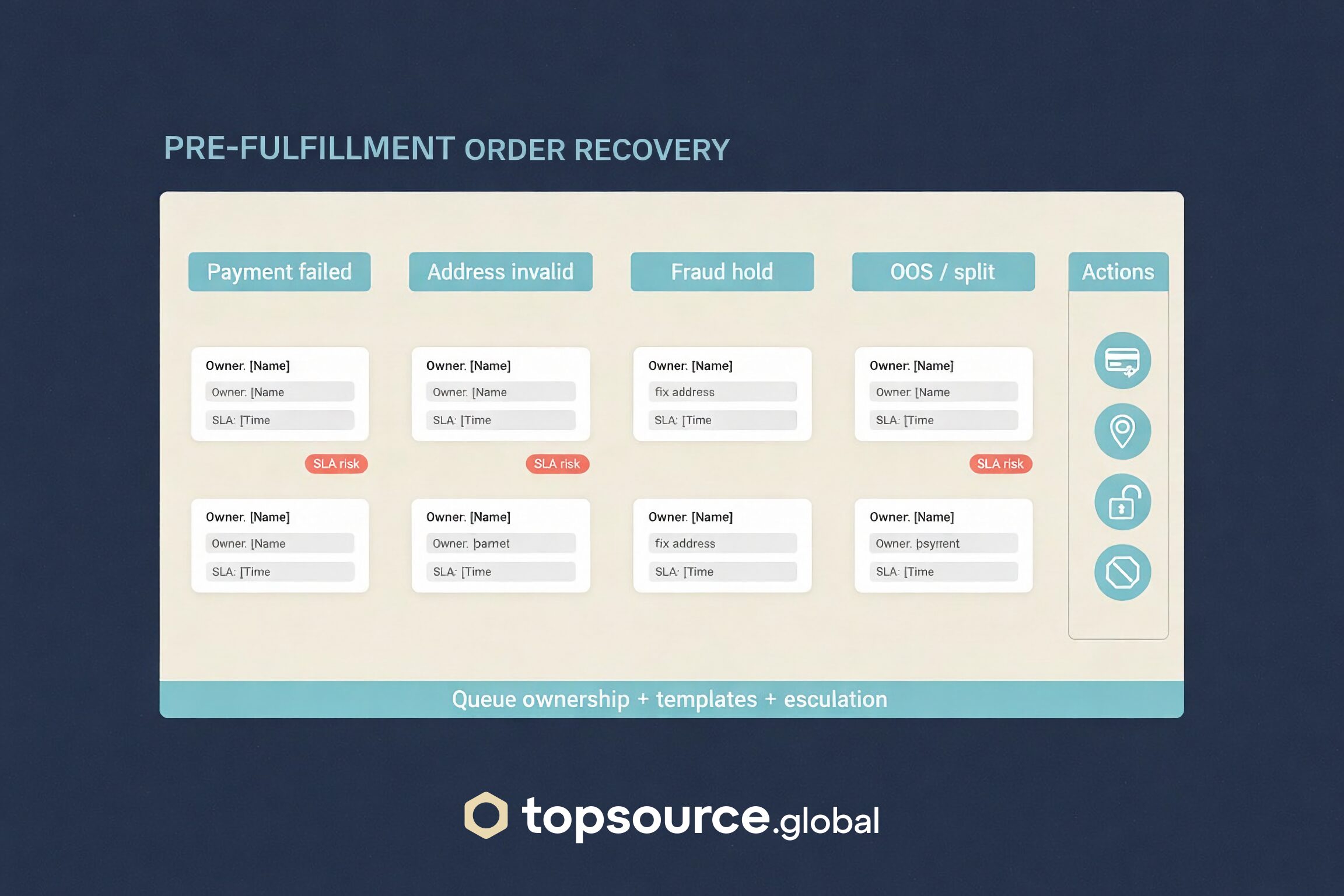
- Payment review / authorization failures that never get resolved
- Fraud holds that block good customers and create delays
- Address issues (invalid, missing apartment, PO box restrictions)
- Inventory mismatch (available online, not available in the warehouse)
- Split shipment confusion (partial availability, unclear ship plan)
- Carrier cutoff misses and warehouse backlog that turns into late shipment
- Customer change requests (cancel, edit, swap) handled too slowly
If these cases are not handled within hours, they turn into cancellations, WISMO contacts, and refund requests. Order retention and recovery services exist to clear these queues before they turn into lost revenue.
Pre-fulfillment order recovery: the Recovery Desk inside your ops
Recovery is an operational function. The goal is simple: move exceptions to a decision fast.
We build a dedicated desk with:
- One intake queue for recovery cases (from orders, tickets, emails, or system holds)
- Triage rules that route cases by risk and time sensitivity
- Playbooks for the top failure modes (so decisions are consistent)
- SLA + escalation so cases do not stall
- Verification so the same issue does not repeat next week
How order retention and recovery services work (workflow)
- Intake
- Orders on hold, failed payments, address exceptions, backorders, 3PL exceptions
- Customer contacts that indicate churn risk (cancel request, delivery complaint)
- Triage (15-30 minutes, not days)
- Classify: fixable now vs needs customer decision vs must cancel
- Assign priority by ship cutoff, promised delivery window, and customer value
- Action
- Fix what is fixable without customer friction (address correction, payment retry, release hold)
- Present options when a decision is required (substitute, split, delay, cancel)
- Customer communication
- Short, specific messages with one ask
- Consistent tone and templates, no long explanations
- Close + verify
- Confirm the order moved forward (released, shipped, delivered, refunded)
- Log root cause and feed it back to ops (inventory, fraud rules, carrier, warehouse)
Order recovery services playbooks (modules)
Pre-fulfillment recovery (70%)
- Payment recovery: authorization retry logic, alternative payment request, manual capture checks
- Fraud hold resolution: fast verification steps, safe release rules, escalation to risk owner
- Address fix + reroute: validation, customer confirmation, carrier restrictions handling
- Inventory mismatch recovery: locate inventory, substitute, split, or set expectations early
- Stop-ship / change requests: intercept rules, warehouse/3PL coordination, customer confirmation
- 3PL exception handling: pick/pack exceptions, label issues, missed cutoffs, carrier handoff gaps
Post-fulfillment retention (30%)
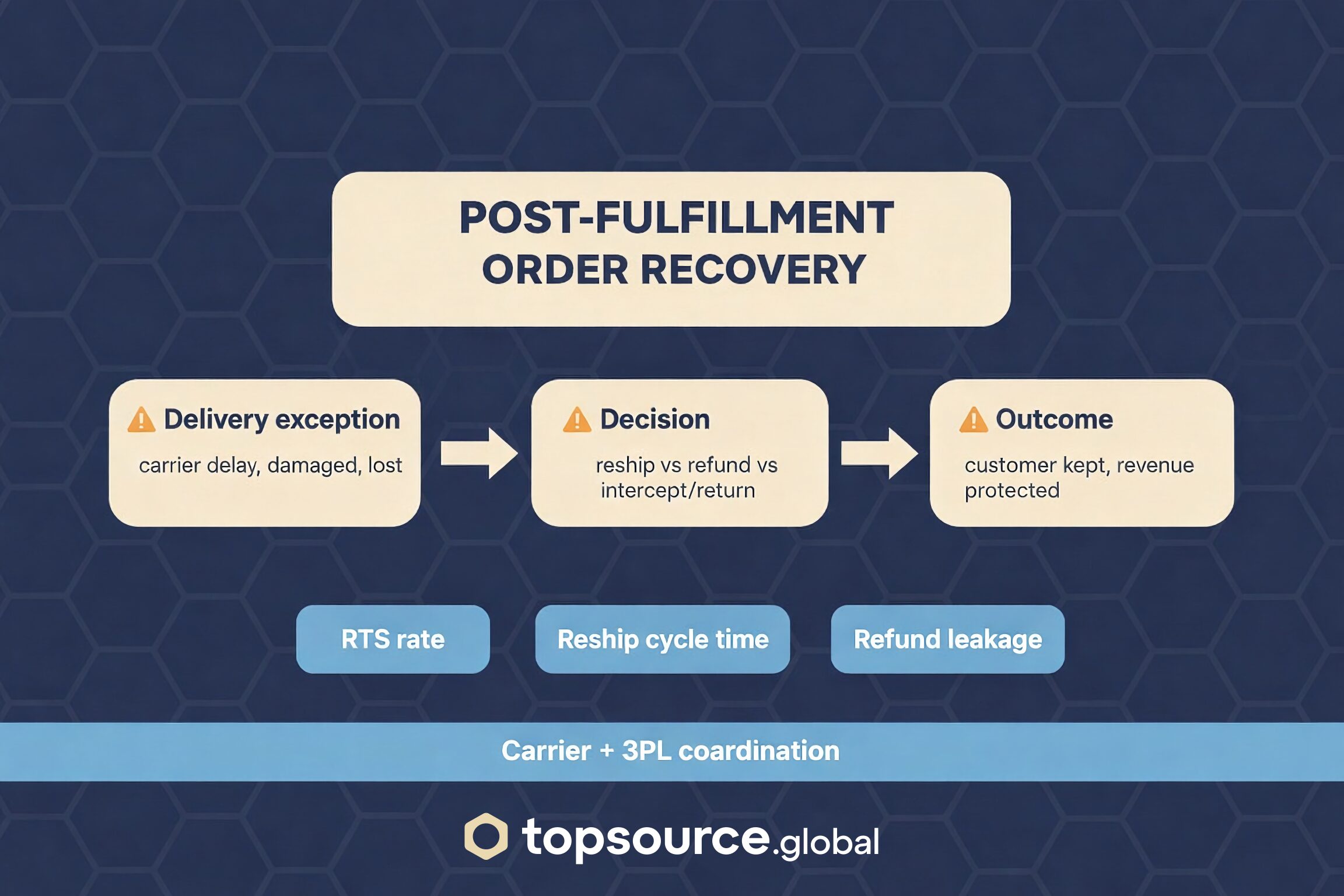
- Delivery exception recovery: delay communication, reroute, replacement vs refund decision tree
- Refund acceleration: prevent repeat contacts, reduce dispute risk, close the loop fast
- Concessions control: standardize when to reship, when to refund, when to deny
- Chargeback prevention support: evidence collection readiness, reason-code patterns, response SLAs
SLAs and ownership
We agree on SLAs per queue. Typical examples:
- Pre-fulfillment holds: first touch within hours
- Cancel/edit requests: decision before warehouse cutoff
- Delivery exceptions: same-day customer update
- Refund-related contacts: clear status and timeline, not vague replies
Every queue has:
- Owner (Recovery Desk)
- Escalation path (Ops lead, warehouse/3PL contact, finance, fraud/risk)
- Definition of done (released, shipped, delivered, refunded, or cancelled with reason)
Integrations (ERP-agnostic)
We work with your existing stack. Typical touchpoints:
- Storefront: Shopify, Magento, WooCommerce
- ERP: NetSuite and others
- 3PL/WMS: your provider portals + shipping systems
- Helpdesk: Zendesk, Gorgias, Freshdesk, email inboxes
- Payments: PSP dashboards and dispute portals
30-day rollout for order recovery services
- Recovery case taxonomy (what counts as recoverable, by category)
- Triage rules and priority model
- Message templates for the top scenarios
- Playbooks for the top 5-10 failure modes
- SLA table + escalation map
- Weekly feedback loop to remove repeatable failure causes
When order retention and recovery services are a good fit
- You process enough volume that exceptions form real queues
- You have multiple systems (storefront + ERP + 3PL + helpdesk) and ownership is fragmented
- You see repeat patterns: holds, cancels, late shipments, delivery exceptions, refund pressure
CTA
Send us a sample of your exception queues (holds, cancels, address issues, delivery exceptions). We will map recovery opportunities and propose order retention and recovery services with SLAs and playbooks.
Related services: cancellation management outsourcing and returns management outsourcing.