


EU right of withdrawal button is not a legal footnote. For US merchants selling into the EU, it becomes a new inbound category that hits live chat and email first, then cascades into cancellations, returns, and refunds.
If you treat it as “just another return request,” you’ll create two problems fast: (1) inconsistent agent replies that trigger repeat contacts, and (2) refund leakage from refunds issued before eligibility is verified. This guide is an ops-first checklist focused on support and compliance communications.
Who this affects (US merchants selling into the EU)
You’re in scope if you ship to EU consumers and take orders directly (DTC or marketplace-like flows where you control customer communications). The operational impact is highest when EU order volume is meaningful and your support team already runs close to capacity.
The first place this breaks is not the warehouse. It’s your support channels: agents get a new phrase customers will use verbatim (“I withdraw”), and your current macros usually don’t handle it cleanly.
What the EU right of withdrawal button creates in real life
The button changes the customer’s behavior. Instead of asking questions (“Can I return this?”), they submit a clear intent statement. Your team will see more of these messages:
- “I withdraw from the contract.”
- “I’m within 14 days, cancel my order.”
- “I want a refund now.”
Those messages look simple, but they map to different operational paths depending on order status (not shipped, shipped, delivered), product type, and whether the request is actually a cancellation, a return, or a refund demand.
Support and compliance comms: what to change before you go live
Build a dedicated response pack for the EU right of withdrawal button requests. You need consistency more than clever wording.
1) Add a dedicated tag + required fields
- Tag: EU_WITHDRAWAL (or equivalent)
- Required fields captured by agent or form: order ID, country, order date, shipment status, delivery status, product category, reason (optional), preferred outcome (cancel/return/refund)
2) Create 3 macros (chat + email) that don’t overpromise
- Acknowledgment: confirm receipt, state next step, give timeline
- Eligibility check: request missing details without sounding like a denial
- Outcome: confirm cancellation/return instructions/refund timing based on the verified path
Rule for agents: do not promise a refund in the first reply. Promise a decision timeline and the next step. That single rule prevents most leakage.
3) Train agents on 4 classification decisions
- Is this pre-fulfillment cancel or post-fulfillment return?
- Is the order shipped or still in pick/pack?
- Is there a delivery exception or RTS risk already?
- Does the customer want replacement, refund, or cancel?
Routing: where these requests should land (chat, email, portal)
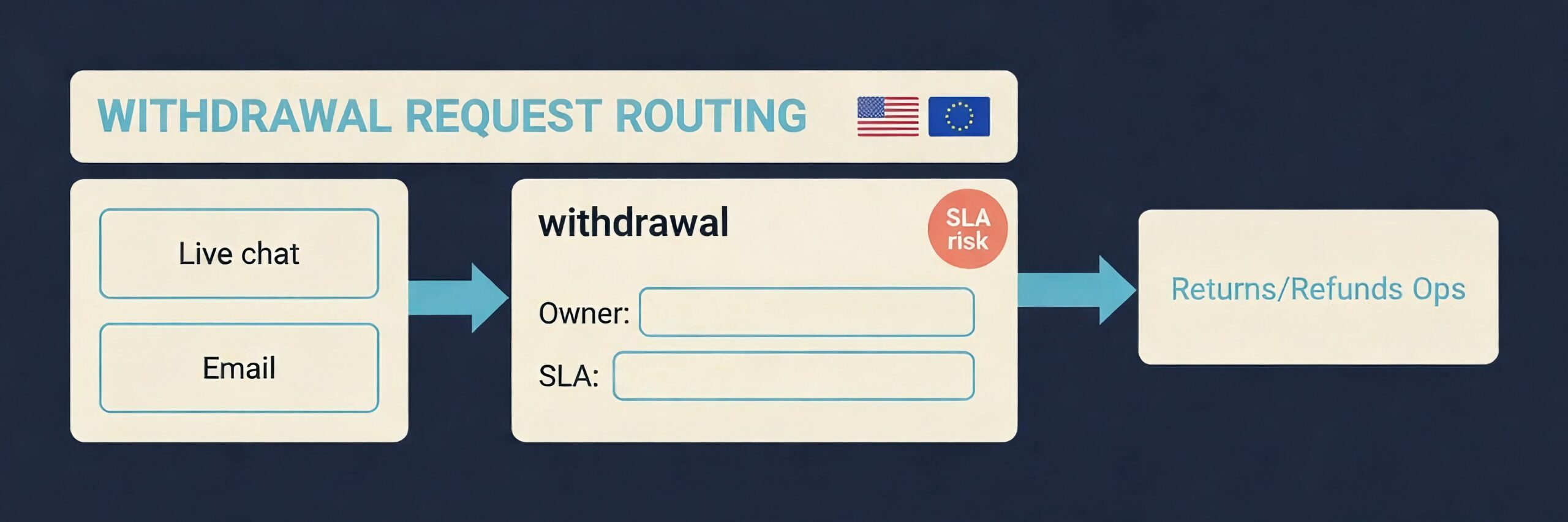
Don’t spread these across general queues. Create a dedicated queue with clear ownership and escalation, even if it’s staffed by the same people.
- Primary channel: live chat for fast capture + structured fields
- Fallback: email for attachments and longer threads
- Optional: portal form if you can enforce required fields
For coverage, EU time zones matter. If you can’t staff EU hours internally, you’ll need a handoff model that prevents overnight backlog. If you’re building or scaling coverage, see our live chat customer support delivery model.
The handoff to returns/refunds ops (avoid refund leakage)
Once the request is classified, the handoff must be deterministic. Agents should not “figure it out” case by case.
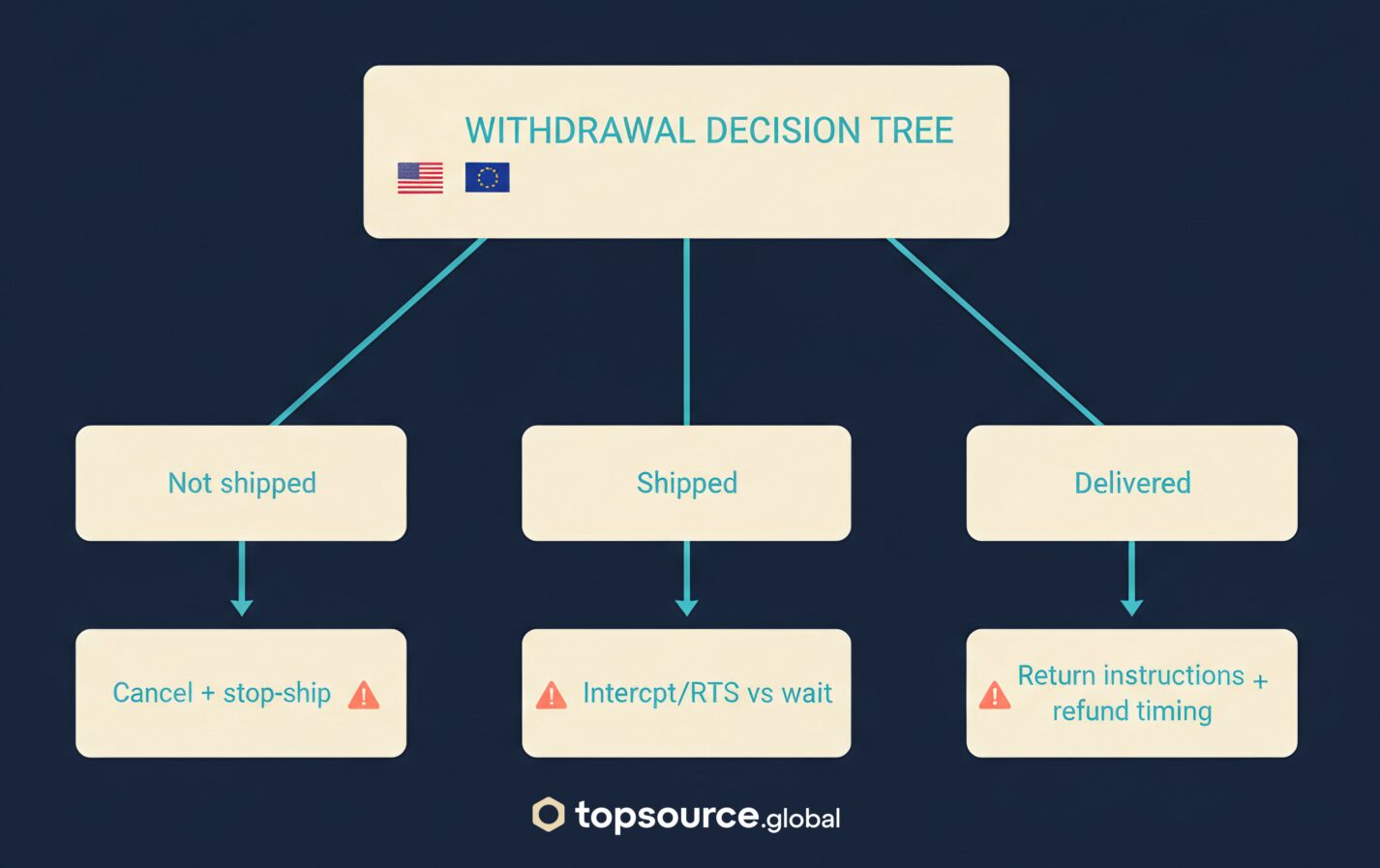
Decision tree (minimal)
- Not shipped: cancel + stop-ship if needed, confirm cancellation
- Shipped, not delivered: decide intercept/return-to-sender vs wait for delivery, set expectations
- Delivered: issue return instructions (RMA/label rules), refund after receipt or per policy
Support should log the same operational fields every time: order status, shipment status, carrier tracking state, and the chosen path. That’s how you prevent duplicate work and inconsistent outcomes.
If you want this run as a managed workflow (queue ownership, templates, QA, and reporting), this maps directly to returns management outsourcing.
Metrics to watch for 30 days after launch
- EU_WITHDRAWAL share: % of inbound contacts that are withdrawal requests
- First response time (EU hours): median and 90th percentile
- Repeat contacts per order: a proxy for unclear comms
- Refund leakage rate: refunds issued before the verified path is complete
- Cycle time: request received to final outcome (cancel/return closed/refund issued)
30-day rollout plan (lightweight)
Week 1: comms pack + tagging
- Define EU_WITHDRAWAL tag and required fields
- Publish 3 macros (acknowledge, check, outcome)
- Run a 30-minute agent training with examples
Week 2: routing + QA
- Route all withdrawal requests into one queue
- Start QA sampling (10-20 tickets/week) focused on overpromising and missing fields
Week 3-4: escalation + reporting cadence
- Define escalation triggers (shipment already tendered, high-value orders, repeat contacts)
- Weekly report: volume, FRT, cycle time, leakage signals, top failure modes
Next step
If you’re selling into the EU and want to avoid a support backlog spike, start with the comms pack and routing. If you want us to map your current queues and build the withdrawal workflow end-to-end, bring us your last 50 related tickets and we’ll identify the leakage points and the fixes.
External references:
European Commission – consumer rights
Directive 2011/83/EU (Consumer Rights Directive)