Automotive E-commerce Returns: NetSuite Workflows That Cut Refund Delays
Artem Balzannikov
Automotive e-commerce returns are not a side process in the US aftermarket. They sit right in the middle of margin, customer trust, and inventory accuracy.
The channel keeps growing, and the operational pressure grows with it: the 2025 Joint E-Commerce Trends and Outlook Forecast says automotive aftermarket e-commerce sales are expected to grow 4.6% in 2025 excluding marketplaces, while total channel sales including Amazon, eBay Motors, and Walmart are projected to grow at a 6.7% annualized rate through 2030.
At the same time, NRF expects 19.3% of online sales to be returned in 2025 across e-commerce. For automotive operators, that combination creates a simple problem: more orders, more exceptions, more refund risk. Automotive e-commerce returns create margin leakage when RMA, refund, warehouse, and finance workflows are not synchronized.
Most teams do not lose money on the sale. They lose it in the loop after the sale. Wrong fitment, duplicate orders, damaged shipments, canceled backorders, and slow approvals turn a return into a labor-heavy workflow. In automotive, where AOV is often higher and SKU catalogs are messy, manual refund handling scales badly.
Why automotive returns break faster than general e-commerce
A beauty brand can often restock a returned item and move on. Automotive is different.
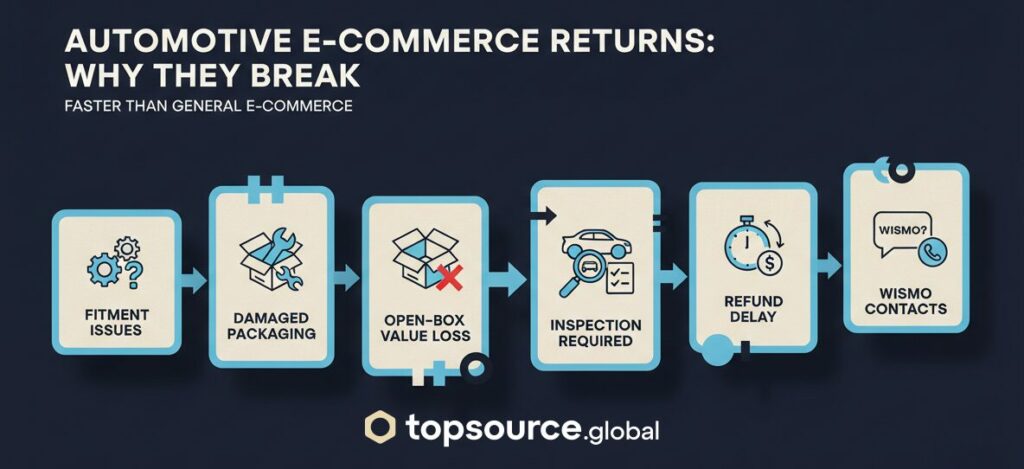
Parts have fitment dependencies. Packaging matters. Open-box value drops fast. Some returns need inspection before resale. Some should never go back to sellable stock. If the refund is issued too early, finance takes the hit. If it is issued too late, support gets buried in WISMO and refund-status contacts.
That is why the weak point is rarely policy. It is workflow design.
Deadlines and evidence standards vary by network, so teams should align their workflow with the official Visa dispute process before building internal SLAs.
Automotive returns break faster when fitment, packaging, inspection, and refund timing create extra operational handoffs.
The hidden cost sits between RMA and refund
A solid chargebacks playbook gives operations, support, and payments teams one shared system for prevention, evidence, and recovery.
Here is where margin leaks in US automotive e-commerce:
agents rekey return data from email or forms
RMAs are created late or with missing fields
warehouse and finance work from different statuses
payment processor refunds are triggered manually
customers ask for updates because nothing is synchronized
NetSuite records do not reflect the real state of the case fast enough
One broken handoff is manageable. Hundreds per week are not.
A better structure for automotive e-commerce returns: request first, refund second
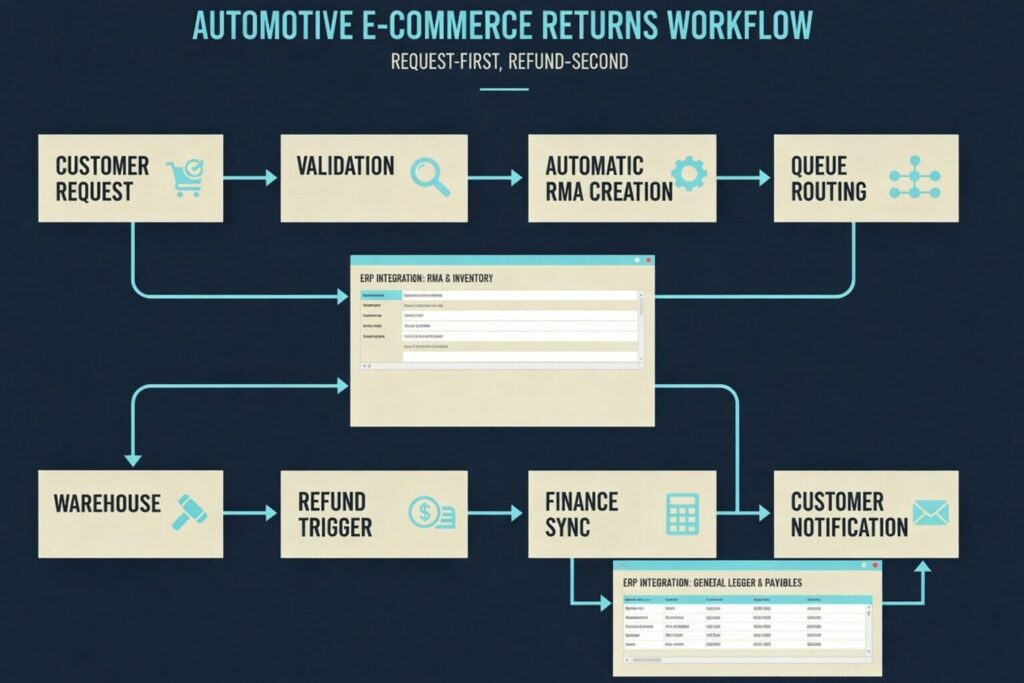
Instead of treating every return like a one-off ticket, strong operators standardize the sequence:
Capture the customer request in a structured format
Validate the reason and required fields
Create the RMA automatically in NetSuite
Route the case to the right operational queue
Trigger refund logic only when the business rule is met
Sync status back to finance and customer communication
This structure matters in automotive because not every return should follow the same path. Wrong part ordered, fitment issue, damaged in transit, fraud-adjacent claim, and canceled fulfillment each need different controls. A stronger returns workflow starts with structured intake, automatic RMA creation, and refund execution only after the right business rule is met.
What this looks like in practice with NetSuite
One useful pattern is to split the workflow into two controlled automations.
First, a structured customer request creates the RMA in NetSuite automatically. That removes manual entry, improves data consistency, and gives operations a clean starting point. TopSource Global has already implemented this approach in its Automatic RMA Creation from Customer Request | NetSuite Workflow.
Second, once the return or cancellation reaches the correct status, NetSuite connects with the payment processor and issues the refund automatically while updating records and notifications. That pattern is shown in Refund Automation | NetSuite ↔ Payment Processor Integration.
The point is not “more automation.” The point is fewer manual decisions in the wrong places.
Why automotive e-commerce returns matter more in the US aftermarket now
The US aftermarket keeps shifting online, and customer expectations are now shaped by mainstream e-commerce speed. Buyers expect compatibility checks, real-time inventory, and fast post-purchase resolution. Industry reporting also points to technology improvements such as real-time inventory management and vehicle compatibility checks as a major driver of online growth.
That raises the bar for operators. If your front end feels modern but your returns and refunds still run through inboxes and spreadsheets, the customer sees the gap immediately.
Automotive e-commerce returns: the weekly control loop
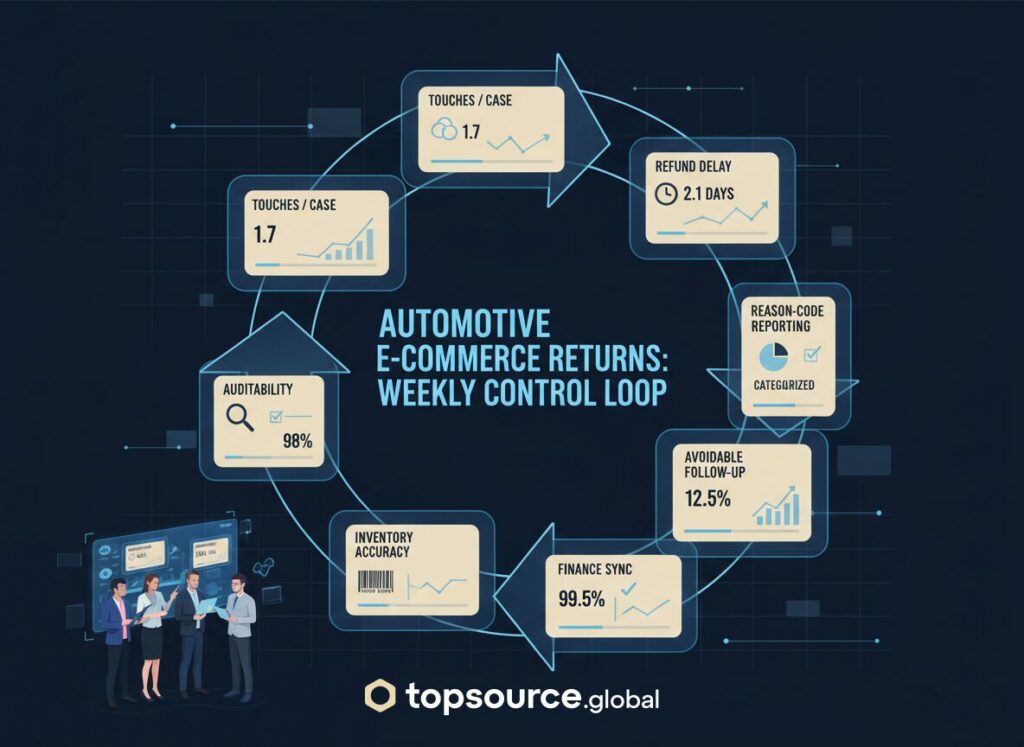
For automotive brands, the target is not just a faster refund. It is a cleaner control loop:
fewer touches per return case
lower refund delay
better auditability between support, warehouse, and finance
cleaner reason-code reporting
less avoidable customer follow-up
more accurate inventory and financial records in NetSuite
That is where operational leverage shows up. Weekly review turns automotive e-commerce returns from a reactive support burden into a controlled operating system.
Final point
Automotive e-commerce returns do not become easier as volume grows. They become more expensive when the workflow stays manual. If you sell parts in the US market, the practical move is to standardize intake, automate RMA creation, and connect refund execution directly to NetSuite and the payment layer.
That is not a theory piece. It is an operating model.
If your team is still handling returns through disconnected steps, this is usually the next fix worth making.
To provide the best experiences, we use technologies like cookies to store and/or access device information. Consenting to these technologies will allow us to process data such as browsing behavior or unique IDs on this site. Not consenting or withdrawing consent, may adversely affect certain features and functions.
Functional
Always active
The technical storage or access is strictly necessary for the legitimate purpose of enabling the use of a specific service explicitly requested by the subscriber or user, or for the sole purpose of carrying out the transmission of a communication over an electronic communications network.
Preferences
The technical storage or access is necessary for the legitimate purpose of storing preferences that are not requested by the subscriber or user.
Statistics
The technical storage or access that is used exclusively for statistical purposes.The technical storage or access that is used exclusively for anonymous statistical purposes. Without a subpoena, voluntary compliance on the part of your Internet Service Provider, or additional records from a third party, information stored or retrieved for this purpose alone cannot usually be used to identify you.
Marketing
The technical storage or access is required to create user profiles to send advertising, or to track the user on a website or across several websites for similar marketing purposes.