


Databricks + NetSuite for e-commerce is the fastest way to stop running the business on delayed, partial, and contradictory numbers. Most US brands can answer “what was revenue yesterday?” but can’t answer “what did we actually earn?” until weeks later – after refunds, shipping adjustments, marketplace fees, and chargebacks land.
This is the pattern we see in mid-market and enterprise e-commerce:
- NetSuite has the financial truth, but it arrives late (close cycles, manual reconciliations, custom fields, workarounds).
- Shopify/Amazon/marketplaces have the operational truth, but it’s fragmented (fees, returns, disputes, shipping events).
- Teams build spreadsheets and point dashboards on top – then argue about which number is real.
A 30-day blueprint is enough to fix the lag and build a margin view you can trust.
Databricks + NetSuite for e-commerce: what “margin blind spots” look like
You don’t need a new KPI library. You need to remove the failure modes that hide profit leakage:
- Refunds posted late or inconsistently (partial refunds, goodwill credits, replacement orders).
- Shipping costs not tied to the order (carrier invoices, DIM adjustments, re-shipments).
- Marketplace and payment fees missing from SKU-level profitability.
- Chargebacks and disputes tracked outside finance until they hit the GL.
- COGS timing issues (receipts vs shipments, landed cost updates, kit/bundle allocation).
- Multiple “order IDs” across systems (Shopify order, marketplace order, WMS shipment, NetSuite sales order).
Databricks is useful here because it can unify these streams into one model, refresh it frequently, and keep lineage and governance clean enough for finance.
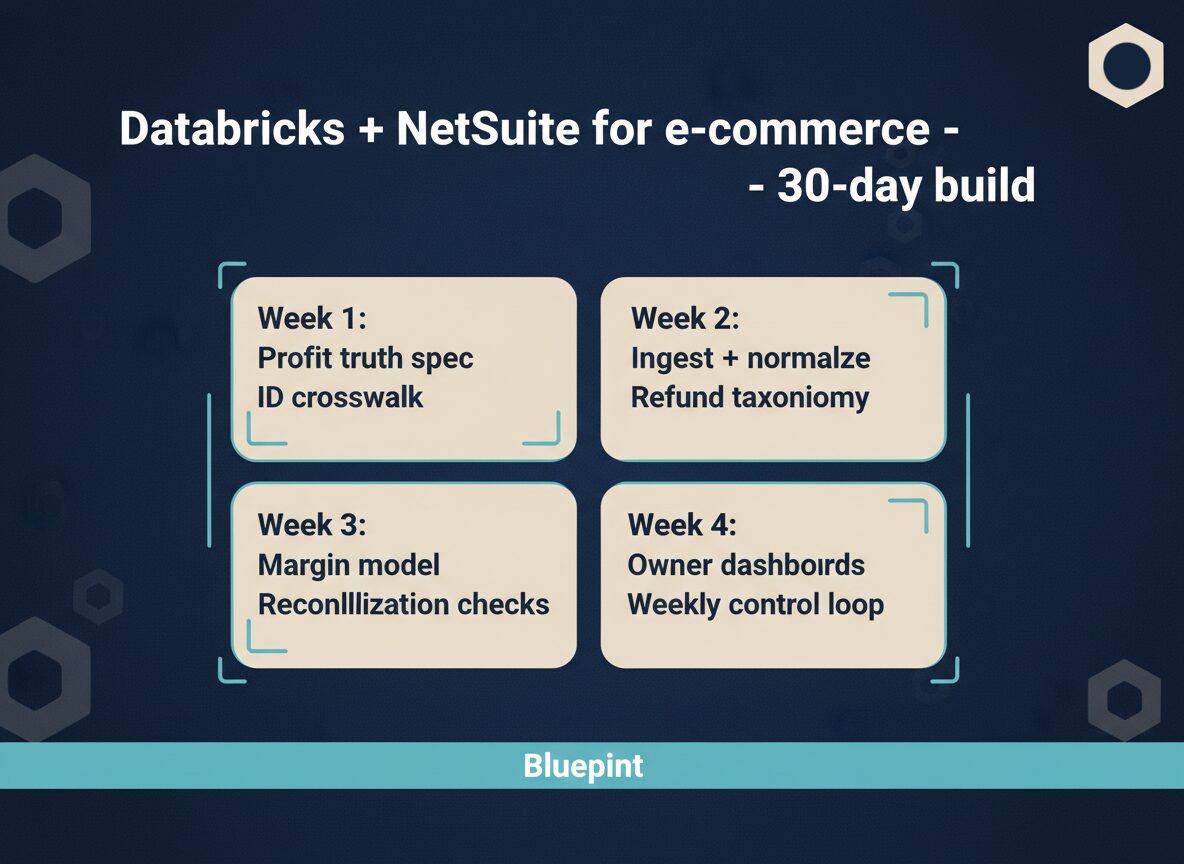
Databricks + NetSuite for e-commerce: the 30-day blueprint (week by week)
Databricks + NetSuite for e-commerce –
Week 1: Define the profit truth and map identifiers
Deliverable: a written “profit truth spec” and an ID map that stops the join chaos.
- Pick the profit grain (what you want to see profit by):
- Order
- Order line (SKU)
- SKU + channel
- SKU + warehouse
- Define the minimum fields you will trust:
- Order date, ship date, delivery date
- Channel, payment method, promo/discount
- Item/SKU, quantity, unit price
- Tax, shipping revenue, fees
- Refund amount, refund reason
- COGS, shipping cost, pick/pack cost (if available)
- Dispute/chargeback status and amount
- Build the ID crosswalk:
- NetSuite sales order / invoice / cash sale
- Shopify/Amazon order ID
- WMS shipment ID
- Carrier tracking number
- Payment processor transaction ID
If you skip this step, every dashboard becomes a debate.
Week 2: Ingest and normalize the core sources
Deliverable: stable ingestion pipelines and a normalized “orders” and “financial events” layer.
Typical sources for US e-commerce:
- NetSuite: sales orders, invoices, item fulfillments, item receipts, GL impact, refunds/credit memos.
- Shopify / marketplaces: orders, refunds, fees, adjustments.
- 3PL/WMS: shipments, picks, re-shipments, exceptions.
- Carriers: tracking events, DIM adjustments, invoice lines.
- Payments: captures, refunds, disputes.
Normalization rules that matter:
- One timestamp standard (timezone, event time vs posting time).
- One currency standard.
- One SKU standard (aliases, bundles, kits).
- One refund taxonomy (return, cancellation, fraud, goodwill, replacement).
Week 3: Build the margin model and the reconciliation checks
Deliverable: a margin model that ties to finance and a set of automated checks that catch drift.
Core tables (simple and durable):
- Orders (operational truth)
- Financial events (captures, refunds, fees, chargebacks)
- Fulfillment events (shipments, re-shipments, exceptions)
- Cost events (COGS, shipping cost, DIM adjustments)
- Profit fact (the joined output at your chosen grain)
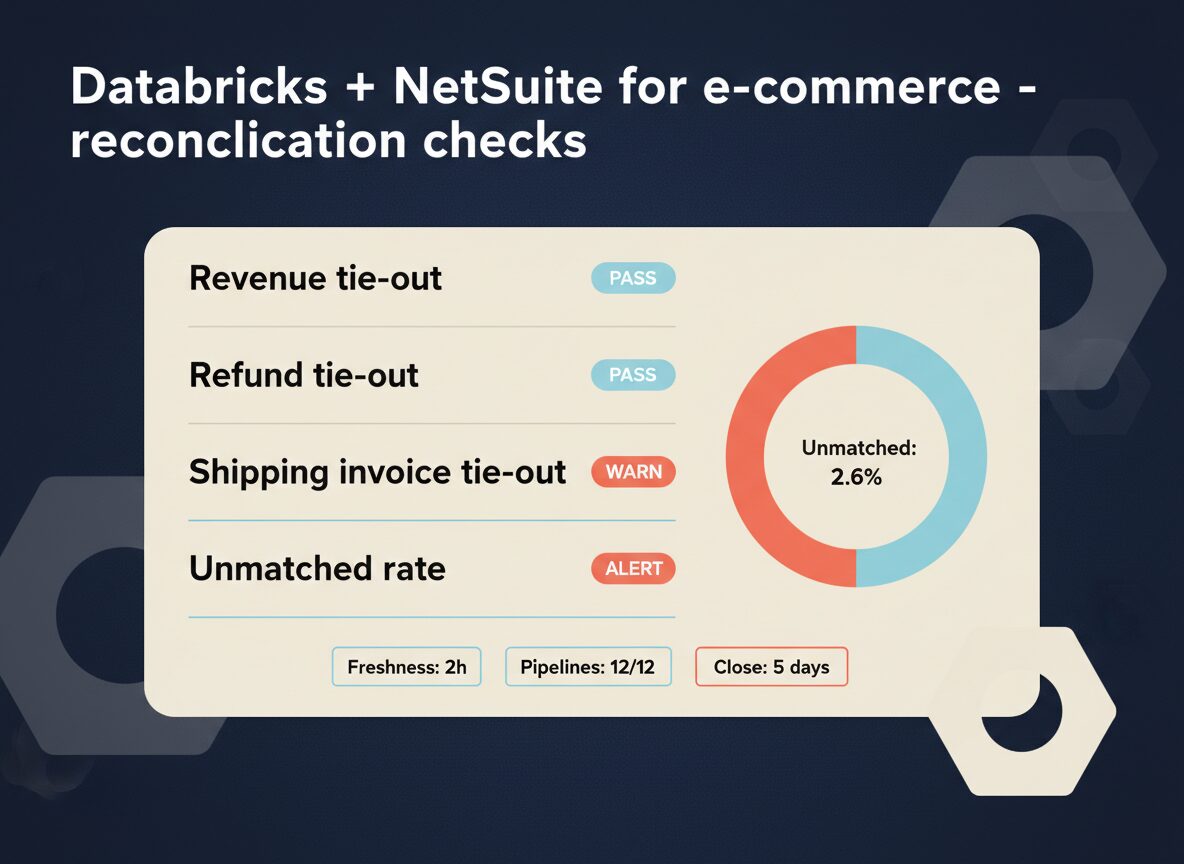
Reconciliation checks you should automate:
- NetSuite revenue vs modeled revenue (by day, channel).
- Refund totals vs credit memos / payment refunds.
- Shipping cost totals vs carrier invoices.
- Disputes open vs disputes posted.
- “Unmatched” rates (orders without shipments, shipments without orders, refunds without original order).
These checks are what make finance comfortable adopting the output.
Week 4: Ship the owner dashboards and the weekly control loop
Deliverable: a small set of dashboards and a cadence that drives action.
Dashboards that owners actually use:
- Profitability by channel and SKU (with fees, refunds, shipping cost included).
- Returns and refund leakage (top reasons, repeat SKUs, replacement rate).
- Shipping cost drift (DIM adjustments, zone creep, re-shipments).
- Disputes and chargebacks (win rate, reason codes, evidence readiness).
- Data health (unmatched rates, pipeline freshness, reconciliation status).
Weekly control loop (60 minutes):
- Review profit deltas vs last week.
- Review top 10 loss drivers (SKU/channel).
- Assign owners (ops, finance, CX) with concrete actions.
- Track outcomes next week.
What Databricks + NetSuite for e-commerce changes in the business
A working Databricks + NetSuite for e-commerce setup changes decisions from “gut feel” to controlled tradeoffs:
- You can cut unprofitable SKUs without killing growth.
- You can fix shipping cost drift before it becomes a quarterly surprise.
- You can reduce refunds by targeting the real reasons (not the loudest tickets).
- You can manage disputes as an operational process, not a finance afterthought.
The point is not “more data”. The point is fewer blind spots.
How TopSource Global helps
TopSource Global builds and runs these pipelines and control loops for US e-commerce teams.
- NetSuite data modeling and finance-grade reconciliation
- Databricks implementation (ingestion, transformations, governance)
- Power BI dashboards built for operators and CFOs
- Ongoing monitoring, QA, and weekly KPI cadence
If you want a fast read on where your margin blind spots are, we can run a short diagnostic and show you what your current data can and can’t answer.