


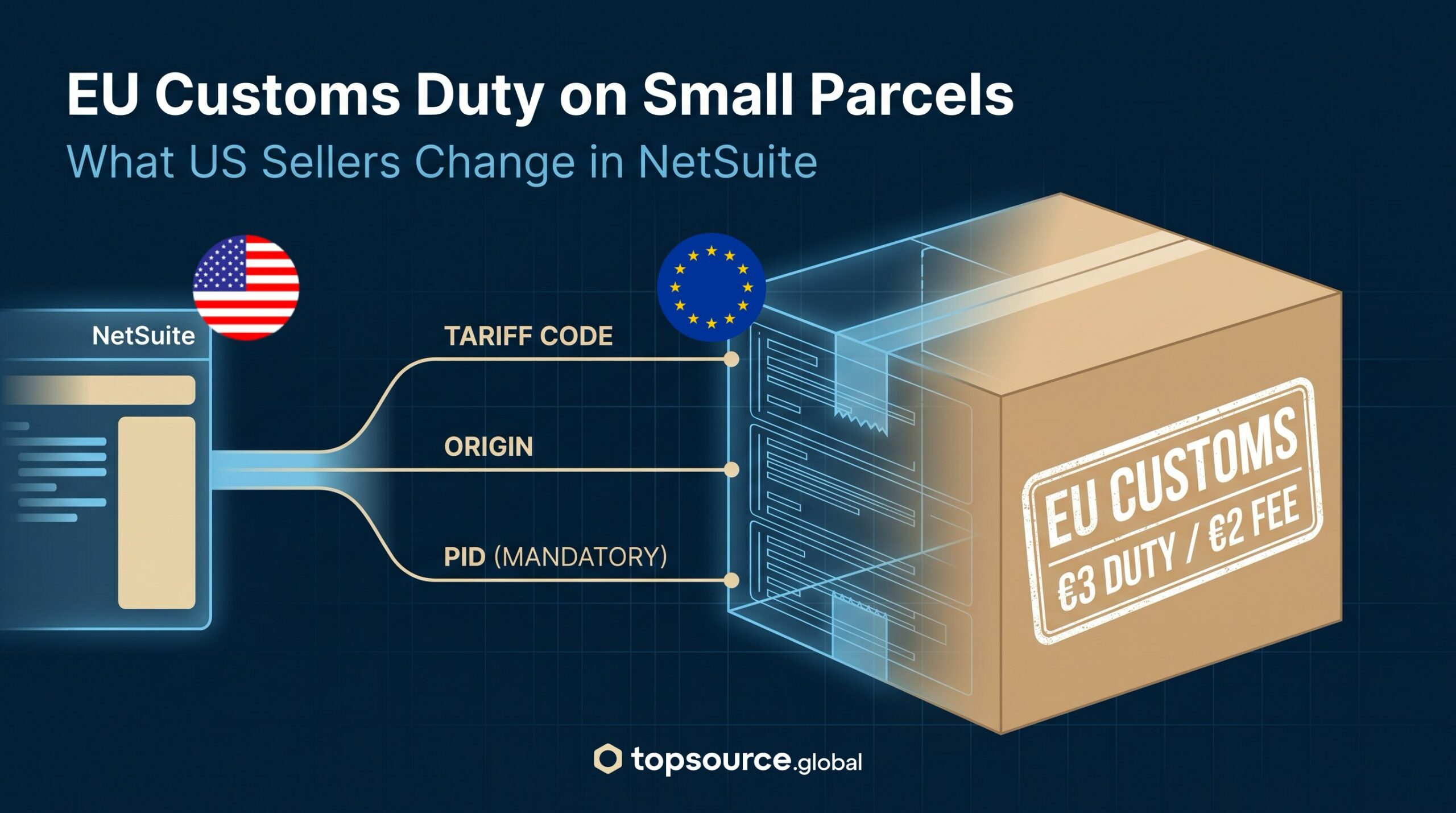
The EU customs duty on small parcels applies to online orders of up to €150 that ship to EU consumers from outside the EU. Since 1 July 2026 the European Union charges a temporary €3 customs duty on these consignments, and a €2 Union handling fee follows on 1 November 2026. A US seller that ships to EU customers from a US warehouse or a US 3PL falls under both.
The charges are small per order. The work is in the data behind them: tariff codes, product descriptions, and customs references on returns. This article lists the dates, explains how the €3 is counted, and shows which NetSuite records and workflows to check before 1 November.
EU customs duty on small parcels: dates and rules
The European Commission’s EU customs reform page sets out the timeline. Product identifier rules come from the Commission’s guidance as reported by trans.info.
| Date | What applies |
|---|---|
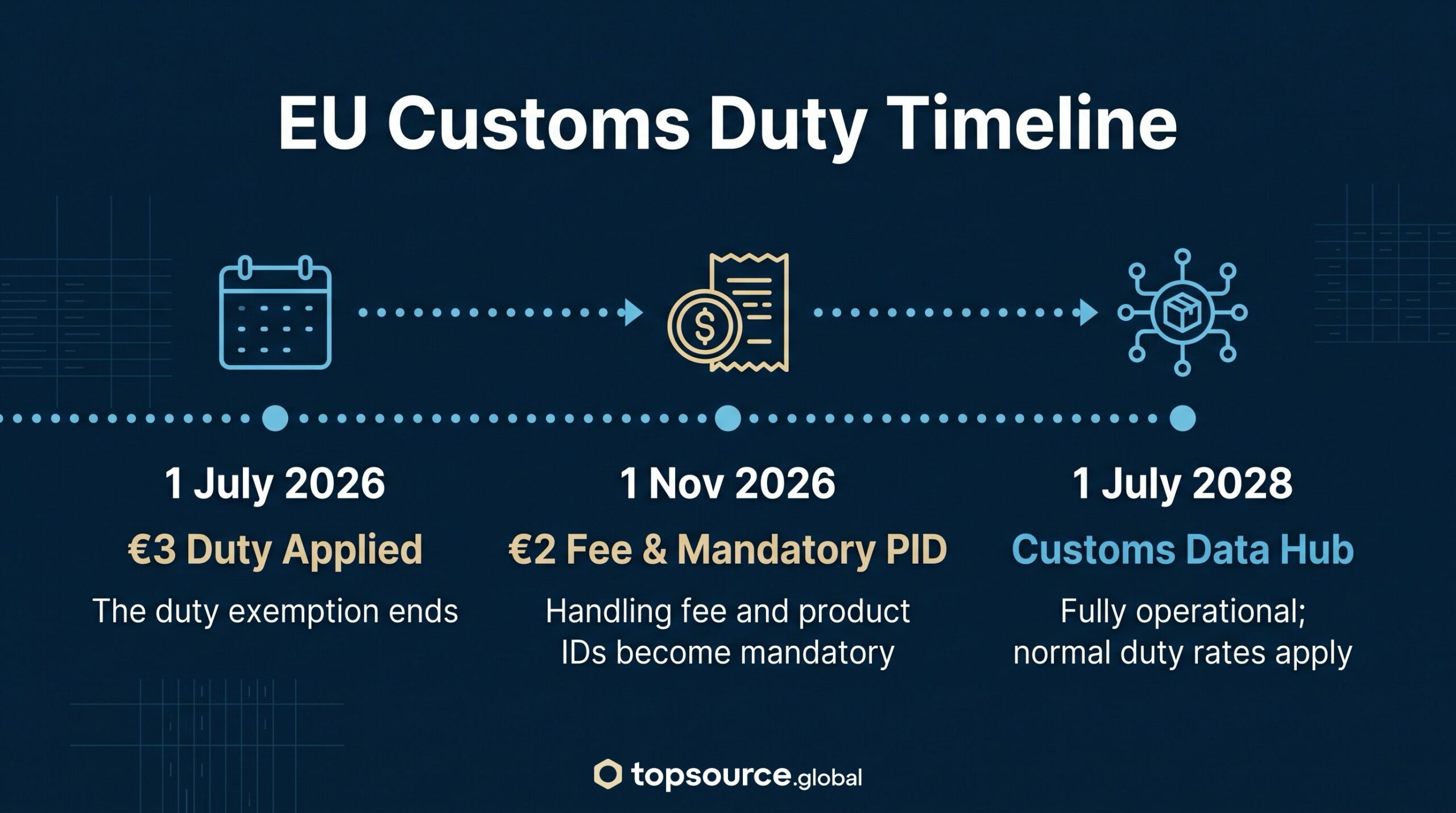
| 1 July 2026 | The duty exemption for consignments up to €150 ended. A temporary €3 customs duty applies instead. |
| 1 November 2026 | The €2 Union handling fee applies. Product identifiers (PID) become mandatory for goods sold through imported distance sales. |
| 1 July 2028 | The temporary €3 duty runs until this date. Use of the EU Customs Data Hub becomes mandatory for e-commerce, and normal customs duties apply once the hub is fully operational. |
Responsibility also moves. Under the new rules, non-EU online platforms and sellers are responsible for customs formalities and duty payments on the goods they sell into the EU, where the consumer carried this responsibility before. Non-compliance carries penalties that include fines, loss of certain customs privileges, and access restrictions.
How the EU customs duty on small parcels is counted
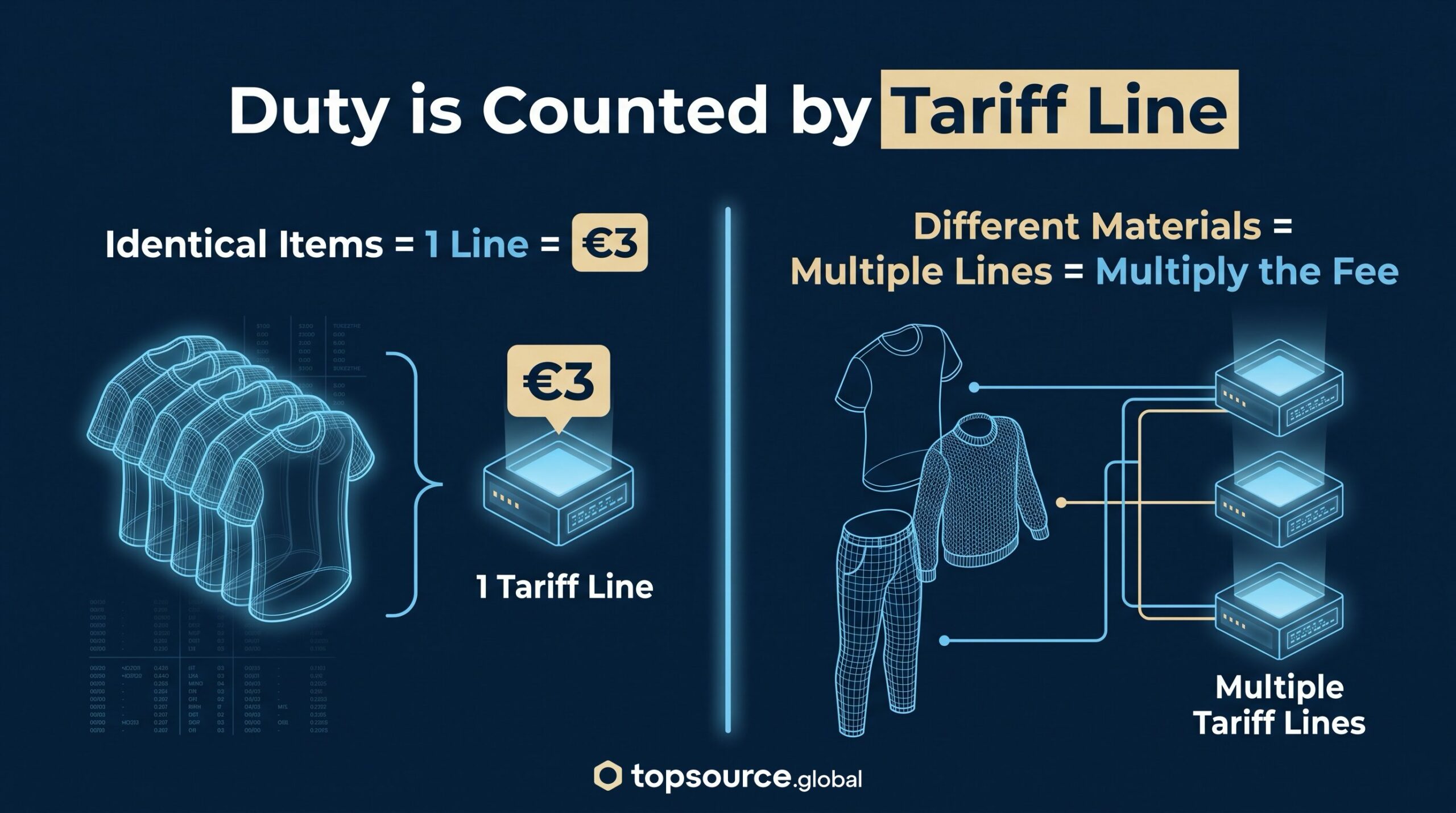
The €3 is charged per tariff line in the customs declaration, not per parcel. Goods that share the same tariff classification, the same description, and where required the same country of origin fall on one line.
Five identical T-shirts in one parcel create one line and one €3 charge. Two pairs of trousers, one cotton and one polyester, can fall under different classifications. They create two lines and a €6 charge. The total therefore depends on how each product is classified and described.
The Commission reports an average value of €8.82 per line item in this segment in the first half of 2025. At that value, €3 equals about a third of the item price, so the duty affects margin on low-priced, mixed baskets.
Product data to check in NetSuite
Each line in a declaration under the EU customs duty on small parcels needs a tariff code, a country of origin, and a description specific enough for a customs broker to classify. Generic labels such as accessories, gift, or parts slow clearance. A useful description states what the product is, what it is made of, and what it is used for.
Check these points in your account before 1 November:
- Where the tariff code, country of origin, and customs description are stored: standard item fields, custom fields, or the 3PL or customs broker system. Confirm that the values match in all of them.
- SKU families that differ in material or composition, because each variant can create its own tariff line.
- Whether a product identifier exists for each SKU sold to EU customers.
- Whether the declared value on the sales order matches the value sent to the carrier.
An item sync between NetSuite and your storefront or 3PL can carry these fields, and a mismatch there is the usual source of wrong declarations. Our guide to integration monitoring for e-commerce covers how to catch sync errors early.
Returns after the EU customs duty on small parcels change
For goods sold through imported distance sales, the Commission’s rules end the simplified cancellation of the customs declaration when goods come back. Refunds of customs duty remain possible under the general rules. Returns therefore take more steps, and they cost more when the original paperwork was incomplete.
EU consumers can withdraw from online purchases, which makes returns a routine flow for EU orders. Three decisions belong in the returns workflow:
- Which record carries the customs declaration reference, so a return authorization can point to the original shipment.
- Who files the duty refund claim: the seller, the 3PL, or the customs broker.
- Where returned goods go: back to the US, or to a return point inside the EU.
Our EU right of withdrawal checklist covers the customer-facing side. If a returns platform feeds NetSuite, the customs reference needs a field in that integration, as described in the Loop Returns NetSuite integration blueprint.
Pricing and checkout under the EU customs duty on small parcels
Checkout needs a rule for the EU customs duty on small parcels: included in the price, or shown as a separate charge. The estimate is only as accurate as the classification behind it. If tariff codes and countries of origin are missing, the checkout cannot show a reliable all-in price.
The €2 handling fee needs its own rule. The Commission’s guidance on the €3 customs duty and the Union handling fee explains how it is applied, and it is updated periodically.
Some sellers will compare these costs with holding stock inside the EU. Shopreturns, a European cross-border returns provider, expects sellers to either localize operations in the EU or absorb the cost on each transaction. For a US seller, the comparison is landed cost per order from the US against the cost of EU storage, EU returns handling, and a second inventory location.
What to finish before 1 November
Preparing for the EU customs duty on small parcels starts with the SKUs that carry the most EU order volume. Confirm their tariff classification and descriptions, add the customs declaration reference to fulfillment and return records, and get the handling fee rule from your customs broker. Then extend the same checks to the rest of the catalog.
TopSource Global works with US e-commerce teams on NetSuite item data, returns workflows, and outsourced order and returns operations. We can review item and returns setup for EU shipments before the handling fee starts. This article is operational guidance, not customs or legal advice. Confirm classification and duty handling with a licensed customs broker.