


Returns management outsourcing is no longer a “nice to have” for e-commerce teams. It’s a practical way to reduce refund cycle time, control exceptions, and protect margin when return volume grows.
This guide breaks down how modern returns operations work, what to measure, where costs hide, and when outsourcing makes sense. It’s written for e-commerce operators, finance teams, and customer support leaders who need a repeatable workflow, clean KPIs, and predictable cost control.
What “Returns Management” Includes (Beyond RMAs)
A real returns operation is a chain of tasks across support, warehouse, finance, and inventory systems:
- Return eligibility checks (policy, time window, item condition)
- RMA creation and labeling
- Carrier coordination and tracking
- Warehouse receiving and inspection
- Disposition decisions (restock, refurbish, liquidate, scrap)
- Refunds, exchanges, and store credits
- Inventory updates and reconciliation
- Chargeback and fraud prevention
- Customer communication and escalation
When this chain breaks, you see the same symptoms: slow refunds, missing inventory, repeat contacts, and margin leakage.
The Returns Workflow (End-to-End)
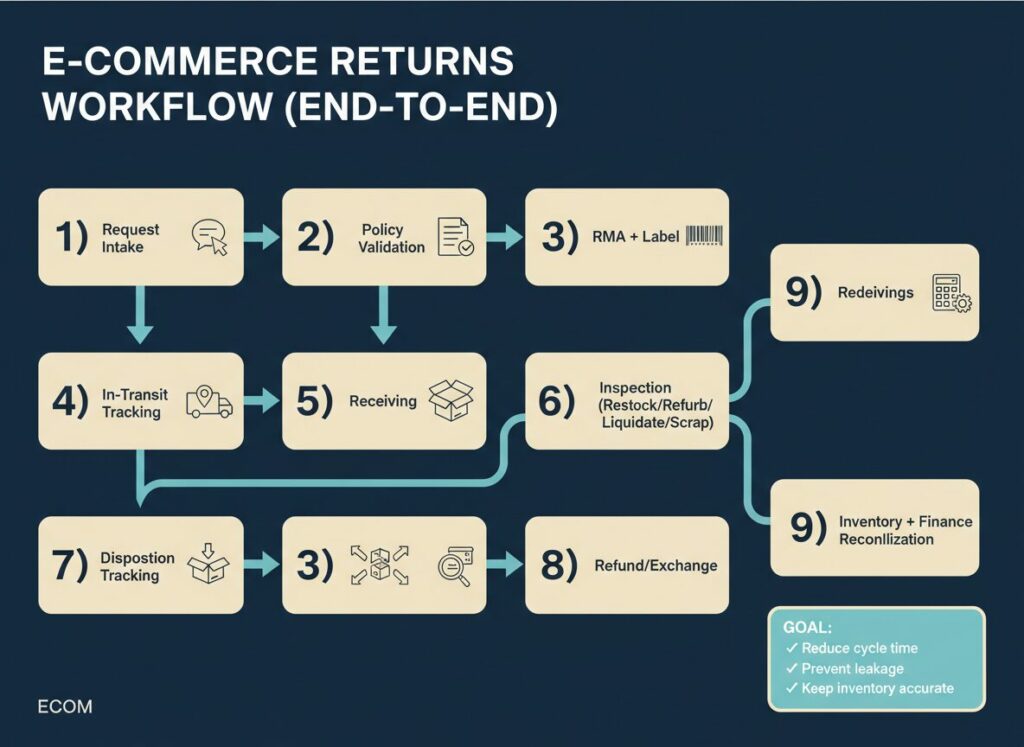
A clean workflow usually looks like this:
- Request intake (email, chat, portal) with required fields
- Policy validation (eligibility + exceptions)
- RMA issued with label and instructions
- In-transit tracking with proactive customer updates
- Receiving + inspection with standardized condition codes
- Disposition (restock/refurb/liquidate/scrap) based on rules
- Refund/exchange triggered by inspection outcome
- Inventory + finance reconciliation (system of record updated)
- Quality review (exceptions, fraud flags, repeat offenders)
The goal is not “process more returns.” The goal is to reduce cycle time, prevent leakage, and keep inventory and financials accurate.
KPIs That Actually Matter in 2026
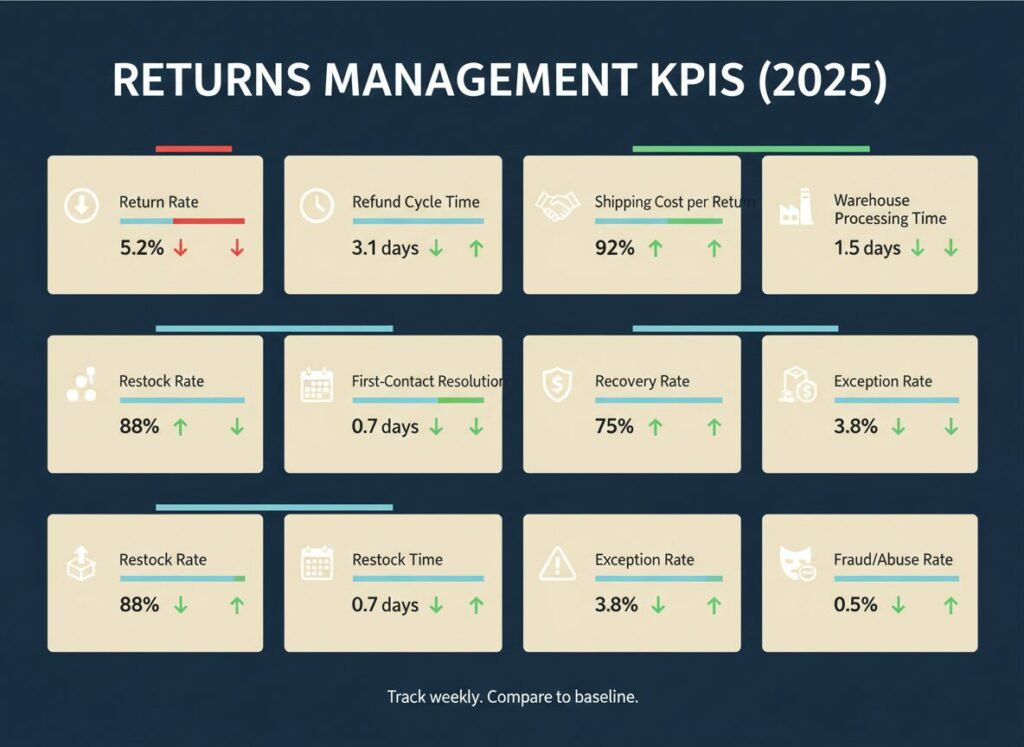
Most teams track volume. That’s not enough. These KPIs connect returns to cost, cash, and customer outcomes:
- Return rate by SKU/category/channel
- Refund cycle time (request → refund) and (delivery → refund)
- First-contact resolution for returns-related tickets
- Return shipping cost per return (and % billed back)
- Warehouse processing time (dock → disposition)
- Restock rate and restock time
- Recovery rate (resale value vs original cost)
- Exception rate (missing items, wrong items, damaged in transit)
- Fraud/abuse rate (empty box, wardrobing, serial swapping)
- Chargeback rate linked to returns and refund delays
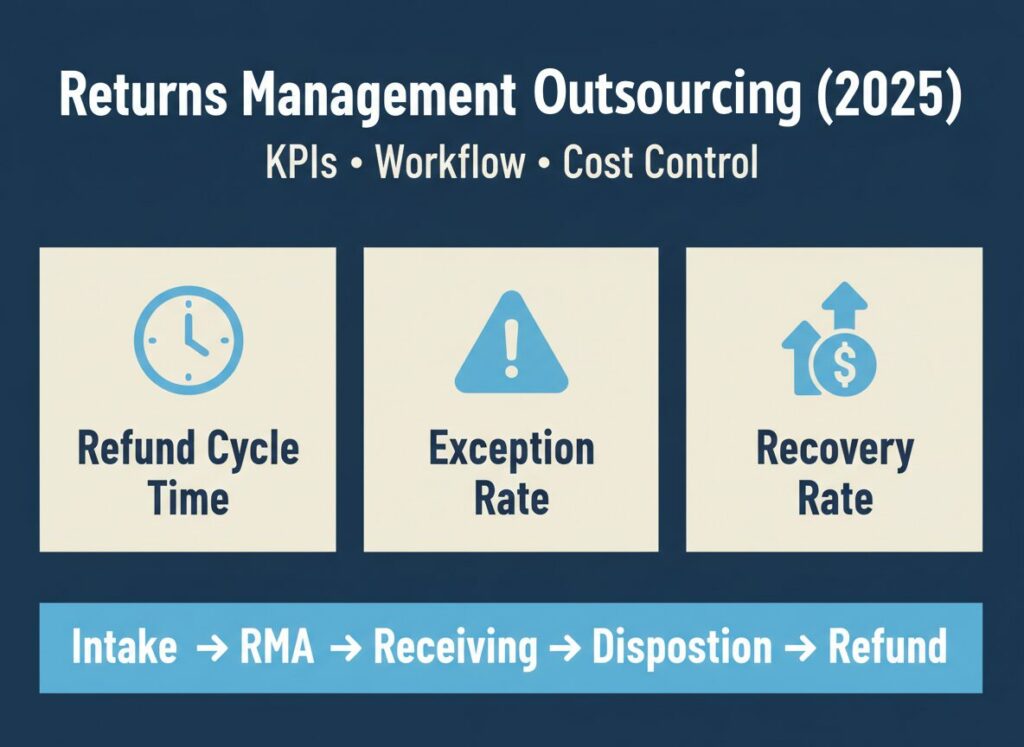
If you want a single “health score,” start with refund cycle time + exception rate + recovery rate.
Where Returns Costs Hide
Returns look like a support problem. In reality, the cost stack is wide:
- Support labor: repeated contacts, escalations, manual approvals
- Shipping: labels, surcharges, failed deliveries, international returns
- Warehouse labor: inspection, sorting, repackaging
- Inventory distortion: items not returned to stock quickly, overselling/underselling
- Refund leakage: refunds issued before inspection, duplicate refunds
- Fraud and abuse: high-cost items, serial number swaps, empty boxes
- Write-offs: slow processing turns sellable stock into dead stock
Cost control starts with standardization: required fields, condition codes, and rules for refunds and disposition.
Outsourcing Returns Management: When It Makes Sense
Outsourcing works best when returns volume is stable (or seasonal), processes are repeatable, and internal teams are overloaded.
Common triggers:
- Refund cycle time is consistently above your target
- Support team spends too much time on returns tickets
- Warehouse receives returns but inventory updates lag
- Exception rate is rising and no one owns root-cause fixes
- Peak season creates a backlog that lasts into the next quarter
A good outsourcing model doesn’t remove your control. It removes the manual load.
What to Outsource vs Keep In-House
A practical split:
Outsource first (high-volume, rule-based):
- RMA intake and validation
- Label issuance and customer instructions
- Tracking updates and customer notifications
- Returns ticket handling (email/chat)
- Exception handling with defined escalation rules
- Reporting and KPI dashboards
Keep in-house (strategic or policy-heavy):
- Policy design (fees, windows, exceptions)
- High-risk fraud decisions (or keep final approval)
- Vendor negotiations and carrier contracts
- Product/quality feedback loops (root cause ownership)
Over time, many teams outsource more once the workflow is stable.
How to Choose a Returns Outsourcing Partner
Returns is cross-functional. Your partner must understand both customer communication and operational controls.
Look for:
- Clear SOPs and condition-code standards
- KPI reporting cadence (weekly) and ownership
- Escalation rules and response-time targets
- Experience with e-commerce tooling (helpdesk + OMS/ERP)
- Fraud and abuse playbooks (not just “process the ticket”)
- Peak-season staffing plan
Avoid providers that only talk about headcount. Returns performance is process + controls + reporting.
Implementation Plan (Typical)
A realistic rollout:
- Week 1: scope, KPIs, access, SOP draft
- Week 2: training, templates, macros, escalation matrix
- Week 3: parallel run (internal + outsourced), QA sampling
- Week 4: handoff, daily check-ins, KPI baseline
- Weeks 5–8: optimization (reduce cycle time, lower exceptions)
The fastest wins usually come from tighter intake requirements and standardized inspection outcomes.
Bottom Line
Returns management is now a profit-protection function. Teams that treat it as a controlled workflow (with real KPIs) reduce refund delays, recover more inventory value, and cut operational waste.
If you want to scale without building a large internal returns team, outsourcing can be a clean move—when it’s tied to process, reporting, and cost control.
Learn more about TopSource Global’s returns operations support here: https://topsource.global/services/returns-management-outsourcing/