


Delivery exceptions operating system is how you stop WISMO from turning into refunds, reships, and endless back-and-forth.
If your support team is buried in “Where is my order?” tickets, you’re paying twice. First in labor. Then in margin when the fastest way out becomes “refund it” or “reship it.” Most teams try to solve this with macros. Doesn’t work.
Same pattern as our order holds playbook: one queue, owners, SLAs, close codes.: one queue, clear owners, tight SLAs, and close codes you can report on.
Delivery exceptions operating system: keep the exception taxonomy lean
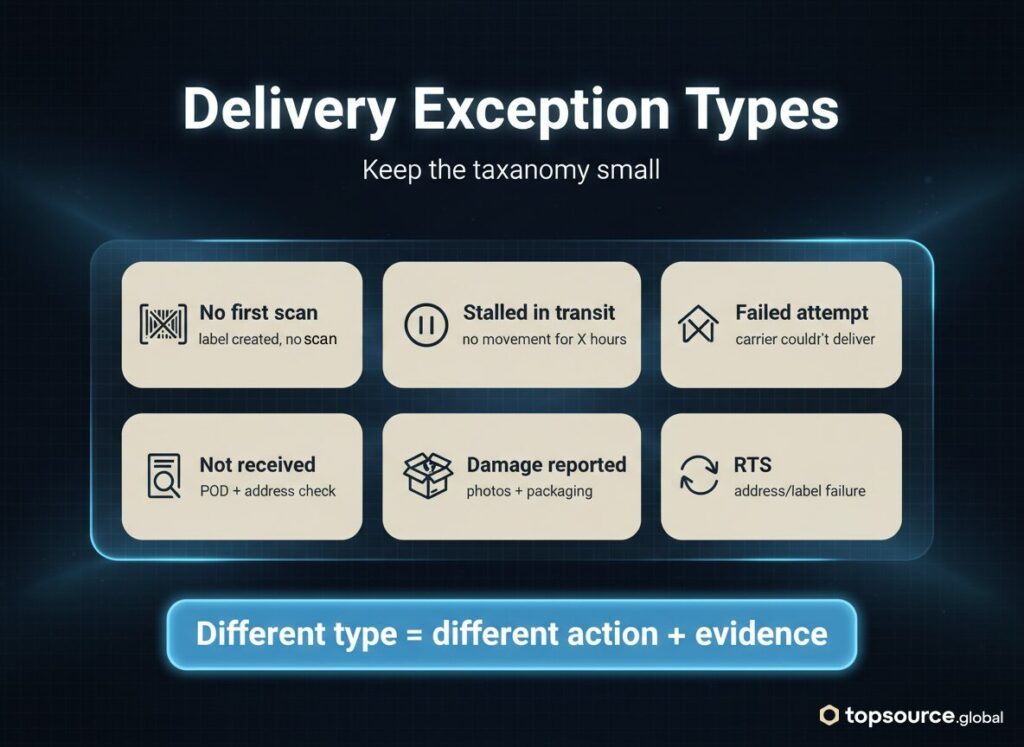
Don’t build 40 statuses. Build a small set that tells the team what to do next.
- No first scan — label created, carrier never pinged it
- Stalled in transit — no movement for X days
- Failed attempt — carrier reached the destination, couldn’t deliver
- Delivered-not-received — phantom delivery (misdelivery or theft)
- Damage reported — arrived, unusable
- RTS — return-to-sender from address/label/handling issues
The 10-second rule: if someone can’t bucket it fast, they’ll guess. Guessing turns into unnecessary refunds.
Split the work: customer resolution vs carrier recovery
Teams blend these into one messy thread and then wonder why nothing scales.
- Customer resolution (speed + trust): refund, reship, store credit, escalation.
- Carrier recovery (evidence + ROI): investigation, claims, follow-ups, payouts.
Refund the customer when you need to protect CX. Fine. Just don’t close the case. Recovery keeps running until the carrier pays or you have a real close reason.
Capture ship-time evidence (or you’ll lose later)
Collecting evidence “after the customer complains” is a losing game. The clock is already running.
Minimum dataset per package:
- Order ID + shipment ID (clean 1:1 link)
- Carrier + service level
- Ship date/time
- Address validation result (pass/fail + what failed)
- Declared vs billed weight/dimensions (billing disputes happen)
- Packer ID + packaging type
- Outbound photo (high-value, fragile SKUs, repeat-loss lanes)
Two rules that move the needle fast:
- Signature threshold for high-value shipments (pick a number, enforce it)
- Outbound photo for fragile SKUs and repeat-loss lanes
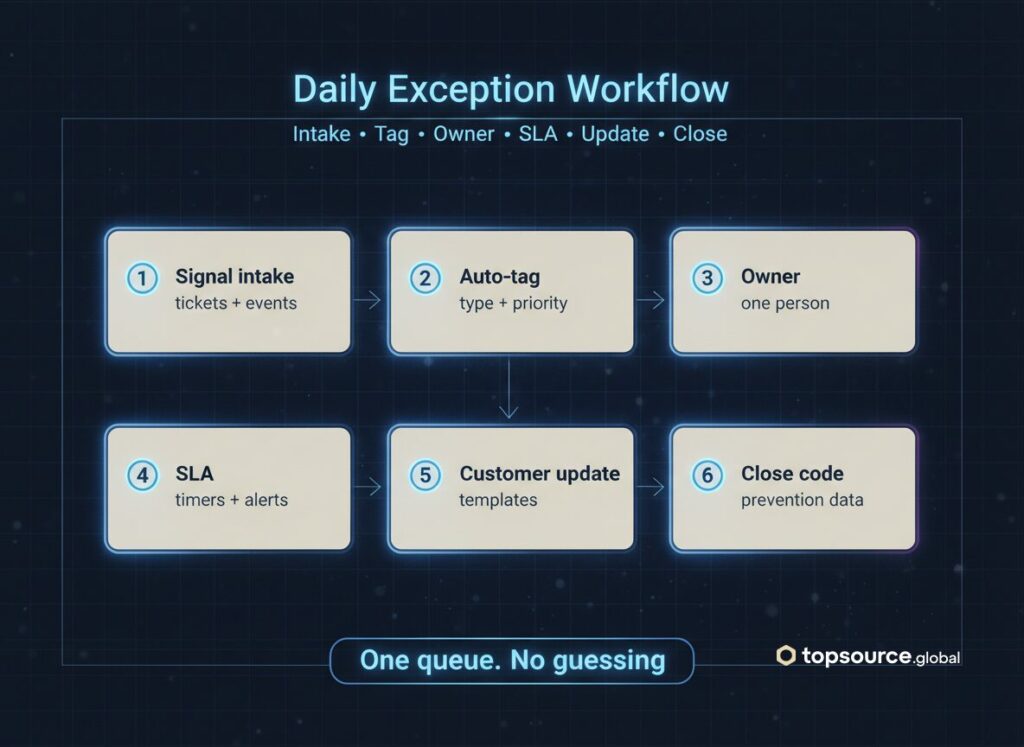
Delivery exceptions operating system: run the daily workflow (intake → tag → owner)
This should feel boring. Boring is good. Boring scales.
Step 1: Aggregate your signals into one queue
Pull candidates from:
- Support tickets (WISMO, damage, misdelivery)
- Carrier tracking events (exceptions, stalls, delivered scans)
- 3PL/WMS timestamps (picked/packed/shipped)
One queue. Not five inboxes.
Step 2: Prioritize what can hurt you today
Don’t over-engineer scoring. Start with a few flags:
- High-value order
- First-time buyer (fraud risk)
- VIP/subscription customer
- Repeat lane / repeat carrier issue
Step 3: Assign a person and a timer
No “team owns it.” A person owns it.
Example SLAs (adjust to your volume):
- Damage reported: request photos within 2 hours
- No first scan: investigate within 4 hours
- Delivered-not-received: same-day action + evidence request
- Stalled in transit: first action within 1 business day
Step 4: Close with reason codes (this is your prevention data)
Every closed exception gets a code:
- Carrier delay
- Warehouse miss (late handoff)
- Address issue
- Misdelivery
- Damage
- Fraud suspected
- Customer error
No close code = no learning = repeat losses.
Keep it alive with a weekly control loop
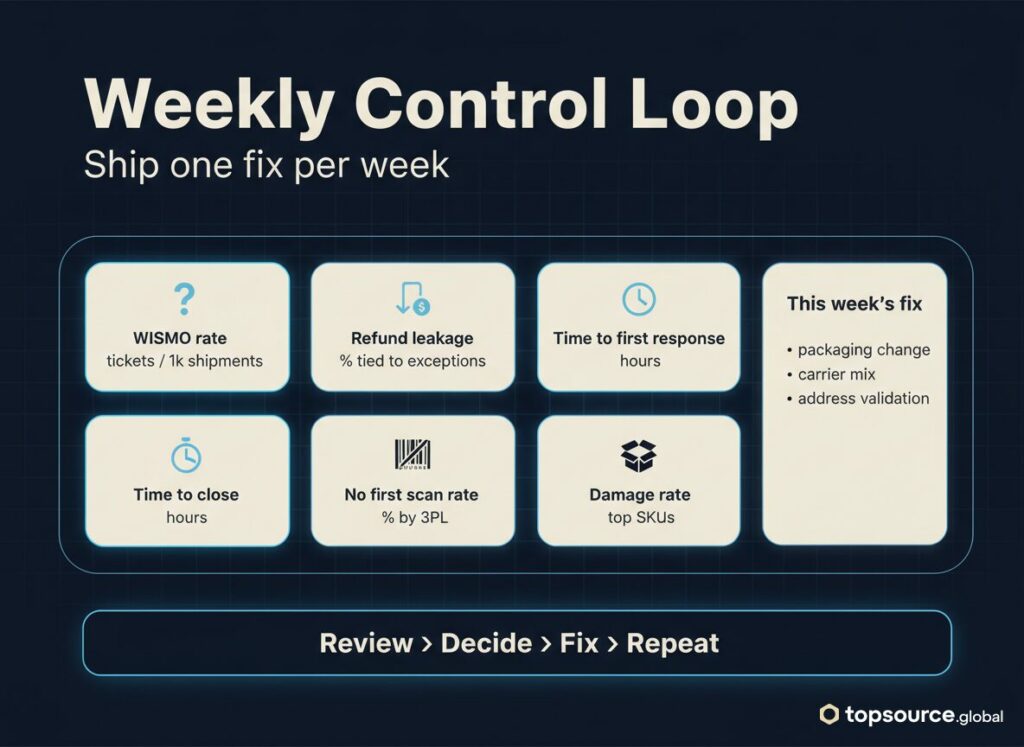
This system dies when nobody reviews it. Put 30 minutes on the calendar.
Track weekly:
- WISMO rate (tickets per 1,000 shipments)
- Refund/reship rate tied to exceptions
- Time to first response and time to close
- Delivered-not-received rate by lane
- No first scan rate by warehouse/3PL
- Top SKUs by damage rate
Then ship one fix per week:
- change packaging for a fragile SKU
- switch carriers for a high-loss lane
- tighten address validation rules
- enforce first-scan compliance (first scan within X hours of ship confirmation)

Review → decide → fix → repeat
What to automate vs what to execute
Automation reduces noise. Execution prevents drift.
- Automate: event detection, tagging, routing, SLA alerts, customer update triggers
- Execute daily: investigations, follow-ups, claim filing, reconciliation
- Keep in-house: refund thresholds, signature thresholds, carrier strategy
Ready for a delivery audit?
TopSource Global helps e-commerce teams build delivery pipelines that don’t rot: ship-time evidence capture, a daily exception queue with owners and SLAs, customer templates, and weekly KPI reporting.
DM us with:
- monthly shipment volume
- top carriers
- current WISMO volume (or “unknown”)
We’ll map the first three fixes to cut ticket volume and refund leakage.