Chargebacks Playbook for E-commerce: Evidence, Rules, and a Weekly Control Loop
Artem Balzannikov
Chargebacks playbook is how high-AOV e-commerce stops losing margin to friendly fraud, messy refunds, and weak evidence.
Auto parts is a perfect storm: expensive orders, split shipments, long delivery windows, and customers who change their mind after the box ships. If your default move is “refund it and move on,” you don’t just lose the product. You train the business to leak.
This is an ops problem, not a payments problem. Build a dispute pipeline: capture evidence early, route cases to owners, close with reason codes, and review weekly.
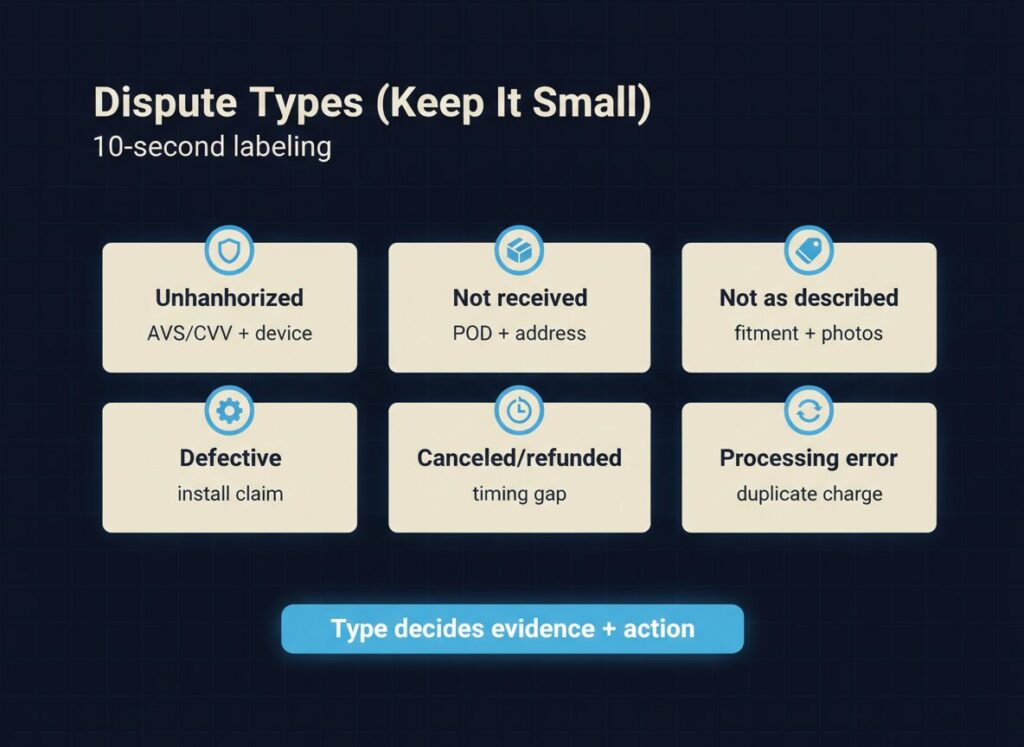
Make the taxonomy match how you actually work. If “not received” and “delivery exception” share the same evidence set, don’t split them into five subtypes.
Chargebacks playbook: capture evidence at order time (not after the dispute)
Representment is a paperwork game with a clock. If you start collecting evidence when the chargeback hits, you’re already late. Deadlines and evidence rules vary by network, so align your workflow with the Visa dispute process.
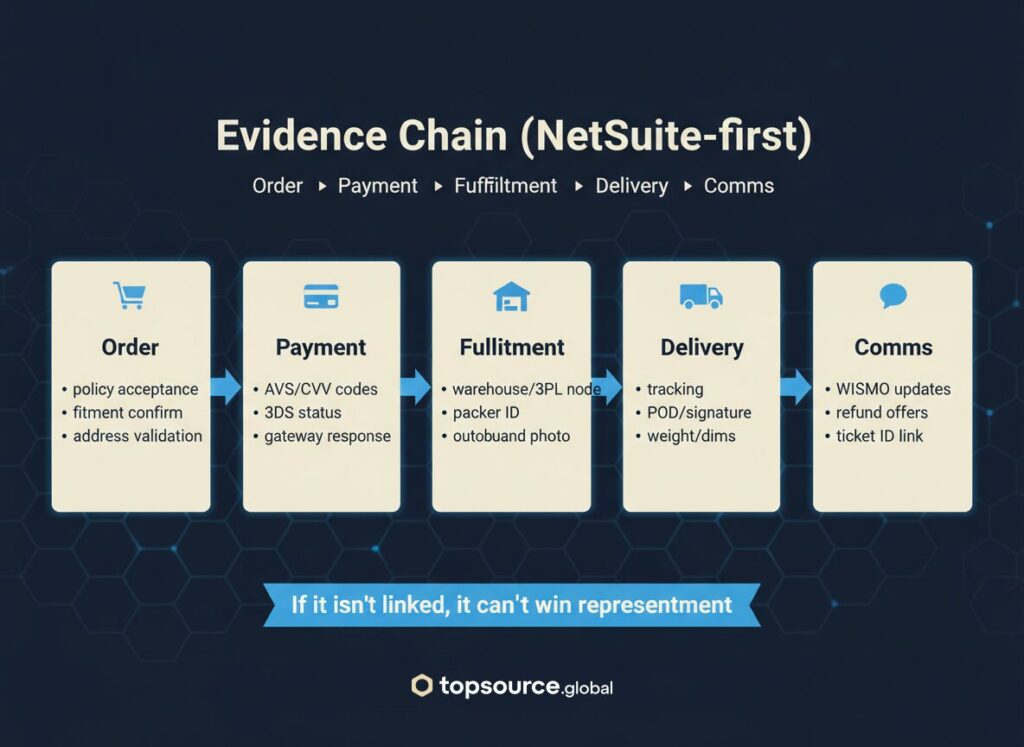
In NetSuite terms: your goal is a clean chain from order → payment → fulfillment → delivery → customer comms → refund/return.
Any concessions (partial refund, reship, store credit)
If your comms live in a helpdesk only, you’re making representment harder than it needs to be. At minimum, link the ticket ID to the NetSuite case/order.
If it isn’t linked, it can’t win representment
Chargebacks playbook: representment rules (fight vs fold)
Winning more disputes isn’t about fighting everything. It’s about fighting the right ones with complete evidence.
Build a simple decision table:
Unauthorized / fraud
Fight if AVS/CVV passed, device consistent, delivery proof strong
Fold if clear mismatch + no signature + customer history is clean
Not received
Fight if signature/POD or clear delivery proof + address validated
Fold if carrier exception + weak proof + high risk of escalation
Not as described / defective
Fight if you have fitment confirmation + install guidance + return path offered
Fold if product data is ambiguous or you can’t prove the customer got the right part
Canceled / refunded
Fight if refund timing proves you already refunded or attempted refund
Fix the root cause if this repeats (it’s usually process drift)
Representment needs an owner and an SLA. If the deadline is 7–10 days and your queue sits unowned for 48 hours, you’re donating money.
Chargebacks playbook: reason codes that drive prevention
Close every dispute with a reason code you can report on. Not a paragraph.
Start with:
Friendly fraud (customer received, denies)
Carrier exception (stalled / misdelivered)
Address issue (validation fail / change request)
Fitment dispute
Damage in transit
Refund timing gap
Duplicate refund
Policy misunderstanding
This is where CFO/COO alignment happens. Reason codes turn support noise into loss categories.
Chargebacks playbook: weekly control loop (KPIs + fixes)
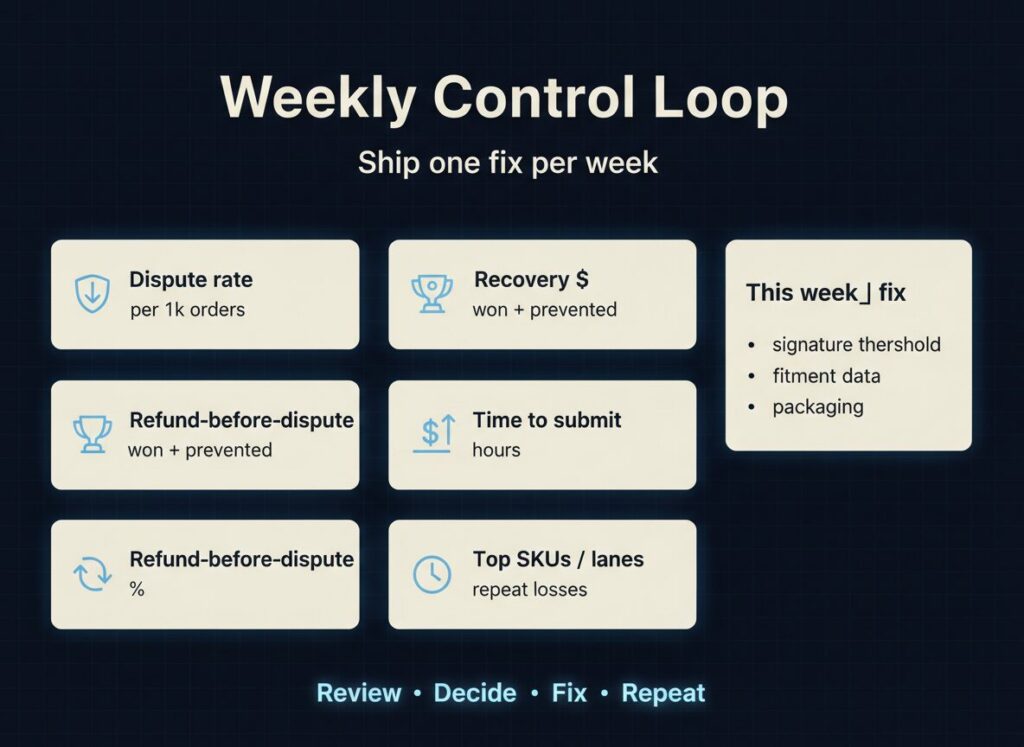
Put 30 minutes on the calendar. Same time every week.
Track:
Dispute rate (per 1,000 orders; by channel)
Win rate (overall + by reason code)
Recovery $ (won disputes + prevented refunds)
Refund-before-dispute % (if this is high, your refund process is drifting)
Time to submit representment (hours)
Top SKUs by dispute rate (fitment and damage patterns)
TopSource Global helps high-AOV e-commerce teams build a chargebacks playbook that actually runs: evidence capture, representment rules, reason codes, and a weekly control loop.
DM us with:
monthly order volume + AOV
top payment gateways
current dispute rate (or “unknown”)
We’ll map the first three fixes to cut dispute losses and stop refund leakage.
To provide the best experiences, we use technologies like cookies to store and/or access device information. Consenting to these technologies will allow us to process data such as browsing behavior or unique IDs on this site. Not consenting or withdrawing consent, may adversely affect certain features and functions.
Functional
Always active
The technical storage or access is strictly necessary for the legitimate purpose of enabling the use of a specific service explicitly requested by the subscriber or user, or for the sole purpose of carrying out the transmission of a communication over an electronic communications network.
Preferences
The technical storage or access is necessary for the legitimate purpose of storing preferences that are not requested by the subscriber or user.
Statistics
The technical storage or access that is used exclusively for statistical purposes.The technical storage or access that is used exclusively for anonymous statistical purposes. Without a subpoena, voluntary compliance on the part of your Internet Service Provider, or additional records from a third party, information stored or retrieved for this purpose alone cannot usually be used to identify you.
Marketing
The technical storage or access is required to create user profiles to send advertising, or to track the user on a website or across several websites for similar marketing purposes.